Events

Filtering by: A.Y. 2025-26
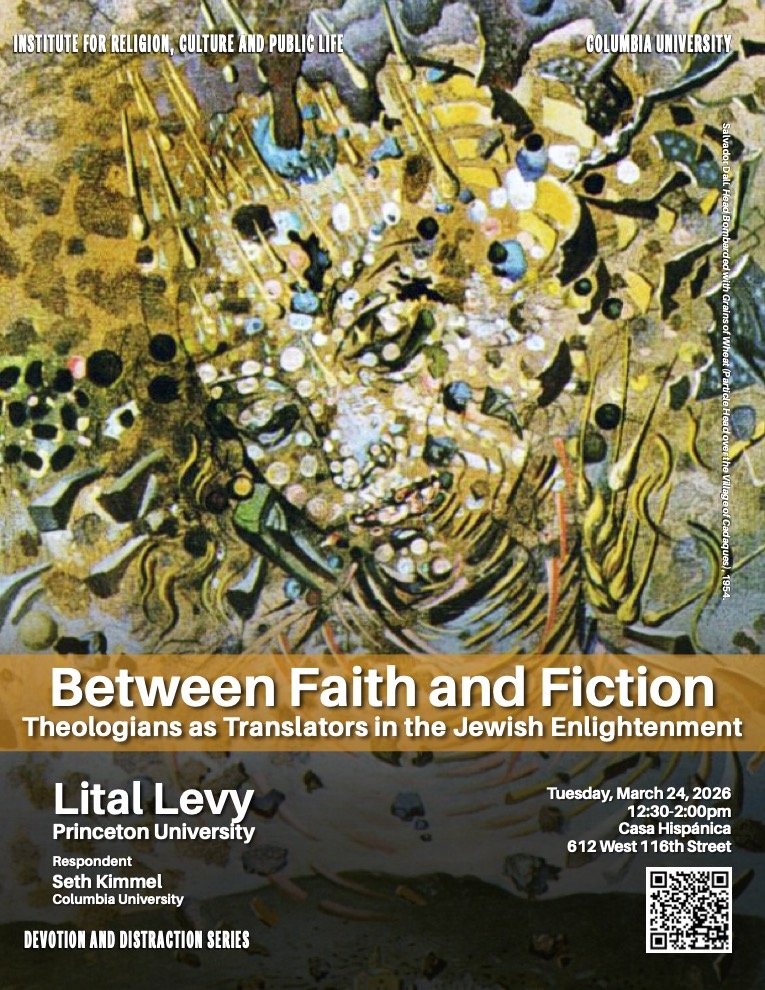
Between Faith and Fiction: Theologians as Translators in the Jewish Enlightenment
Jan
27
12:30 PM12:30

Between Faith and Fiction: Theologians as Translators in the Jewish Enlightenment

In a simple story that we now tell ourselves about secularization, the European Enlightenment plays a key role: It’s the period when scientific inquiry and rational thought became ascendent, while religious practice receded to a more limited private sphere, a shift that coincided with new paradigms of toleration and liberty. The truth is of course more complicated, as theologians from various religious communities reimagined both religious practice and belief in dialogue with the philosophical and political trends of the moment. Along with their neighbors from other religious communities, how did participants in the Jewish Enlightenment, or Haskalah, come to view the new distractions, technological transformations, and dream of universal knowledge that characterized modern life before the eighteenth and nineteenth centuries?

View Event →
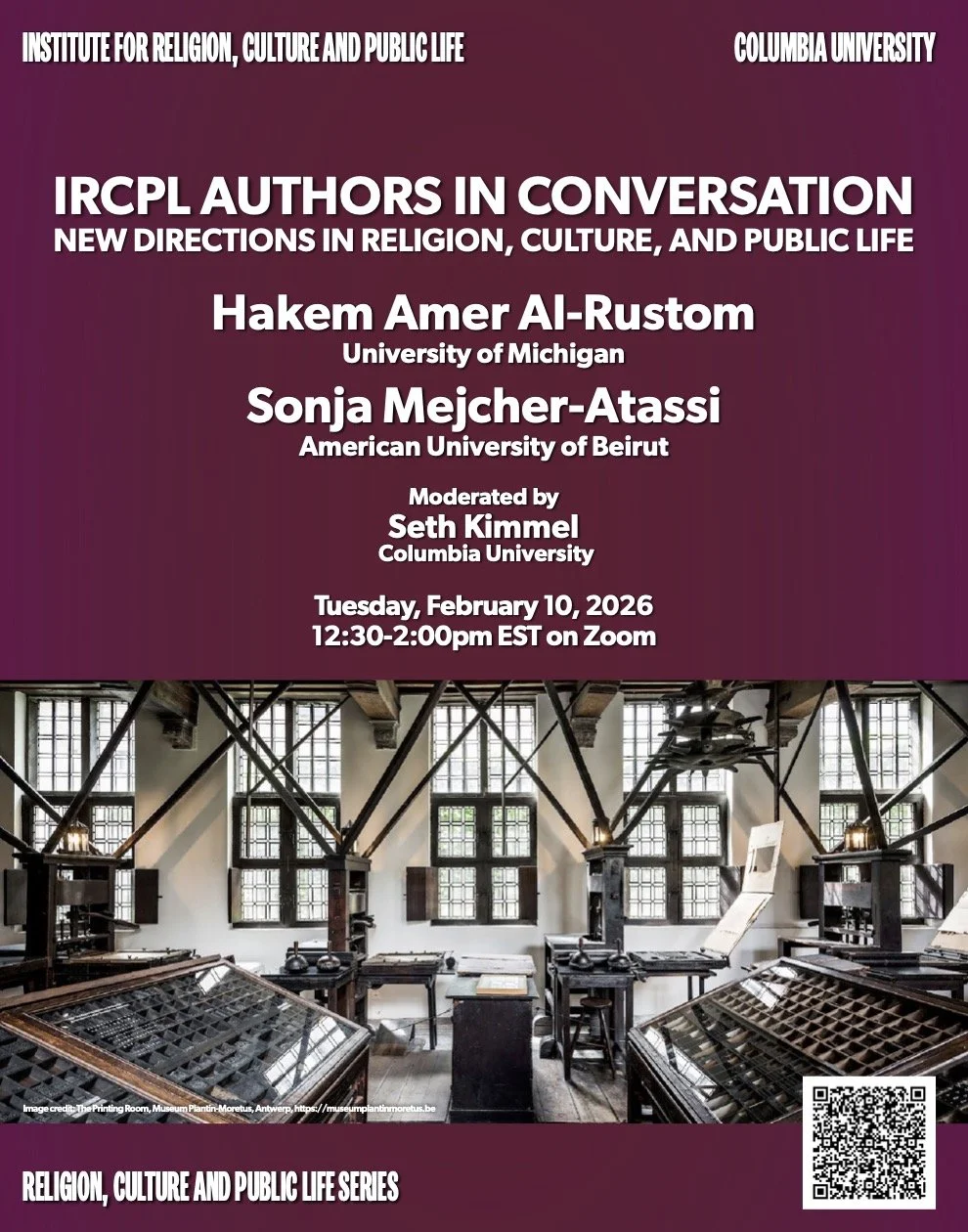
IRCPL Authors In Conversation: New Directions in Religion, Culture, and Public Life
Feb
10
12:30 PM12:30

IRCPL Authors In Conversation: New Directions in Religion, Culture, and Public Life

Topics at the intersection of religion, culture, and public life have taken on special urgency in our current moment of social and political upheaval. Join us for an online conversation with recent IRCPL list authors to reflect on what scholarship has looked like in recent years, and to think together about where it could or should head in the future. 

View Event →
Feb
26
12:30 PM12:30

Premodern Information Overload

With the sense of possibility occasioned by each new technology of the written word, the aspiration to know all that there is to know takes on new life. But even as the printing press or the e-book have at the moment of their invention promised to increase access, they also have led to an exponential increase in new texts. Moreover, although strategies of information management have shifted over time, the feeling of information overload is recurrent and transhistorical. It certainly is not unique to the age of print culture or the internet era. Medieval and early modern Islamic scholars, working with manuscripts and pursuing research across a range of interrelated encyclopedic genres, honed myriad techniques for organizing and retrieving knowledge. How might we weave together these histories of information management and the religious sciences?

View Event →

Nov
17
12:30 PM12:30

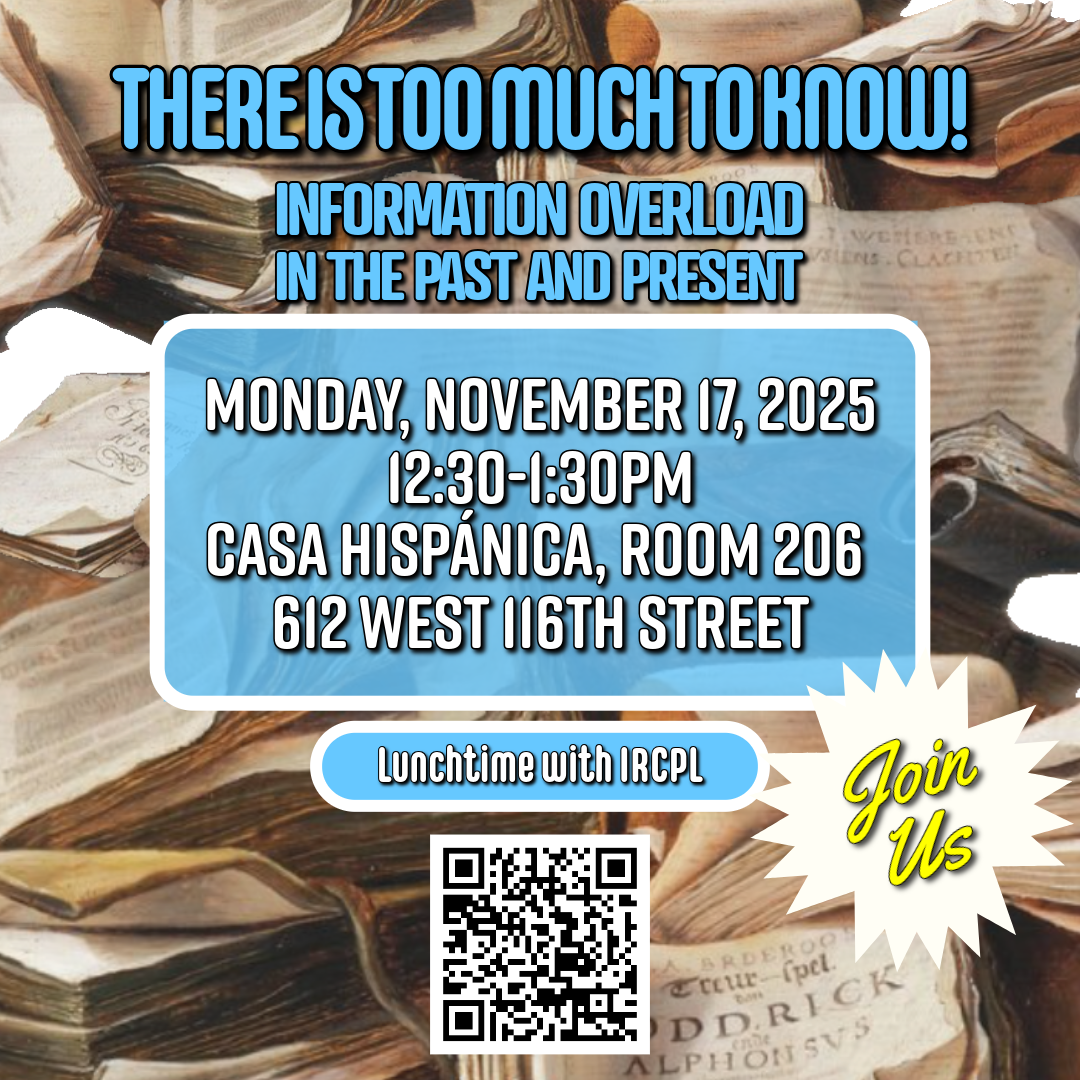
Lunchtime With IRCPL

There is Too Much to Know!  Information Overload in the Past and the Present 

Monday, November 17, 2025, from 12:30-1:30pm

Location: Casa Hispánica, Room 206 (612 West 116th Street)

Do you feel like there is too much to know? Does it seem like your professors are overburdening you with reading assignments, even though you and they both know that you're only scratching the surface?

If you answered "yes" to either of these questions, then you're in the good company of students, teachers, and researchers since just about forever! 

Come have lunch with IRCPL Director Seth Kimmel to talk about how readers and writers in the past have dealt with information overload, and to see what we might learn from their strategies today. 

Lunch provided and all are welcome. 

Registration is requested, but not required. Reserve your spot here

View Event →
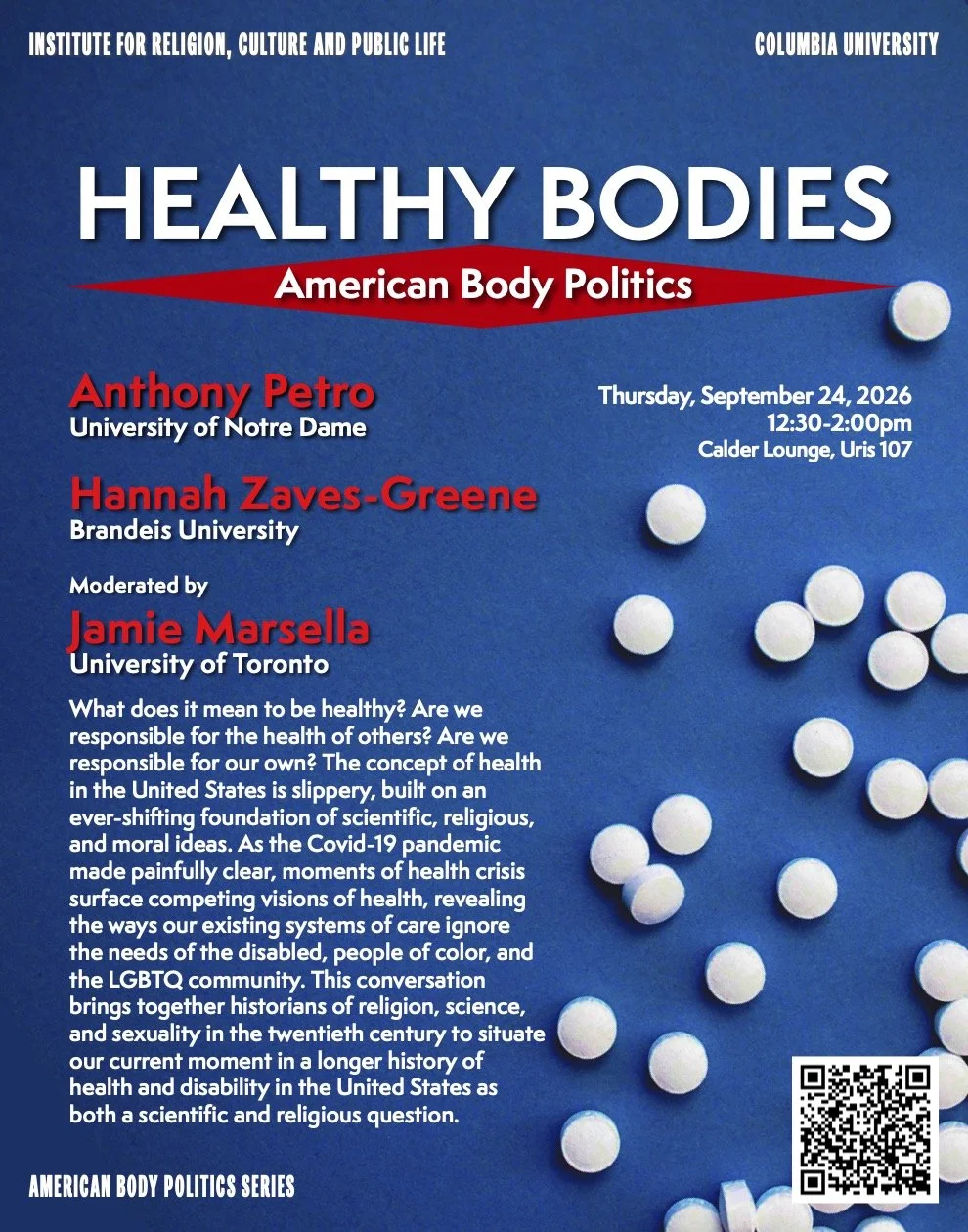
 American Religion is…Healing
Nov
12
5:30 PM17:30

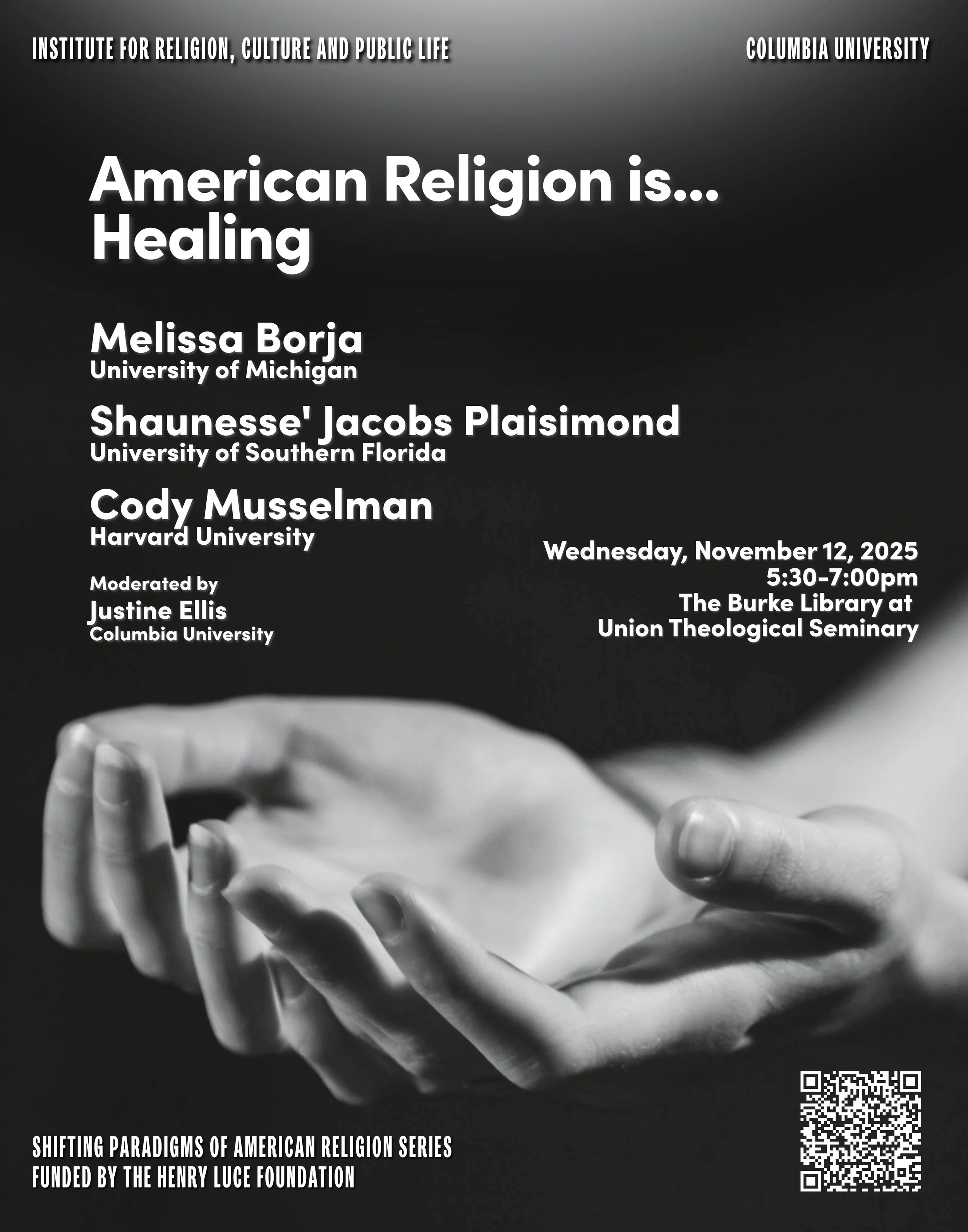
American Religion is…Healing

  • Burke Library at Union Theological Seminary (map)
  • Google Calendar ICS

When it comes to health and wellness, Americans are divided on whether religion is healing or harming. Recent years have shown how our bodies can become sites of vulnerability and contestation, but do our religious identities and communities serve as sources of dignity and individual autonomy or as barriers to access and accurate information? The “American Religion is…Healing” program offers new perspectives on how we can move past this kind of binary thinking, focusing instead on how ideas about religion and spirituality shape not only American public health approaches, but also the information we classify as credible or conspiracist. Join us for a conversation about what it means to feel well and to live well in precarious times.

View Event →
IRCPL Authors In Conversation: New Directions in Religion, Culture, and Public Life
Nov
6
12:30 PM12:30

IRCPL Authors In Conversation: New Directions in Religion, Culture, and Public Life

Topics at the intersection of religion, culture, and public life have taken on special urgency in our current moment of social and political upheaval. Join us for an online conversation with recent IRCPL list authors to reflect on what scholarship has looked like in recent years, and to think together about where it could or should head in the future.

View Event →
American Religion is…Surveillance
Oct
28
5:30 PM17:30

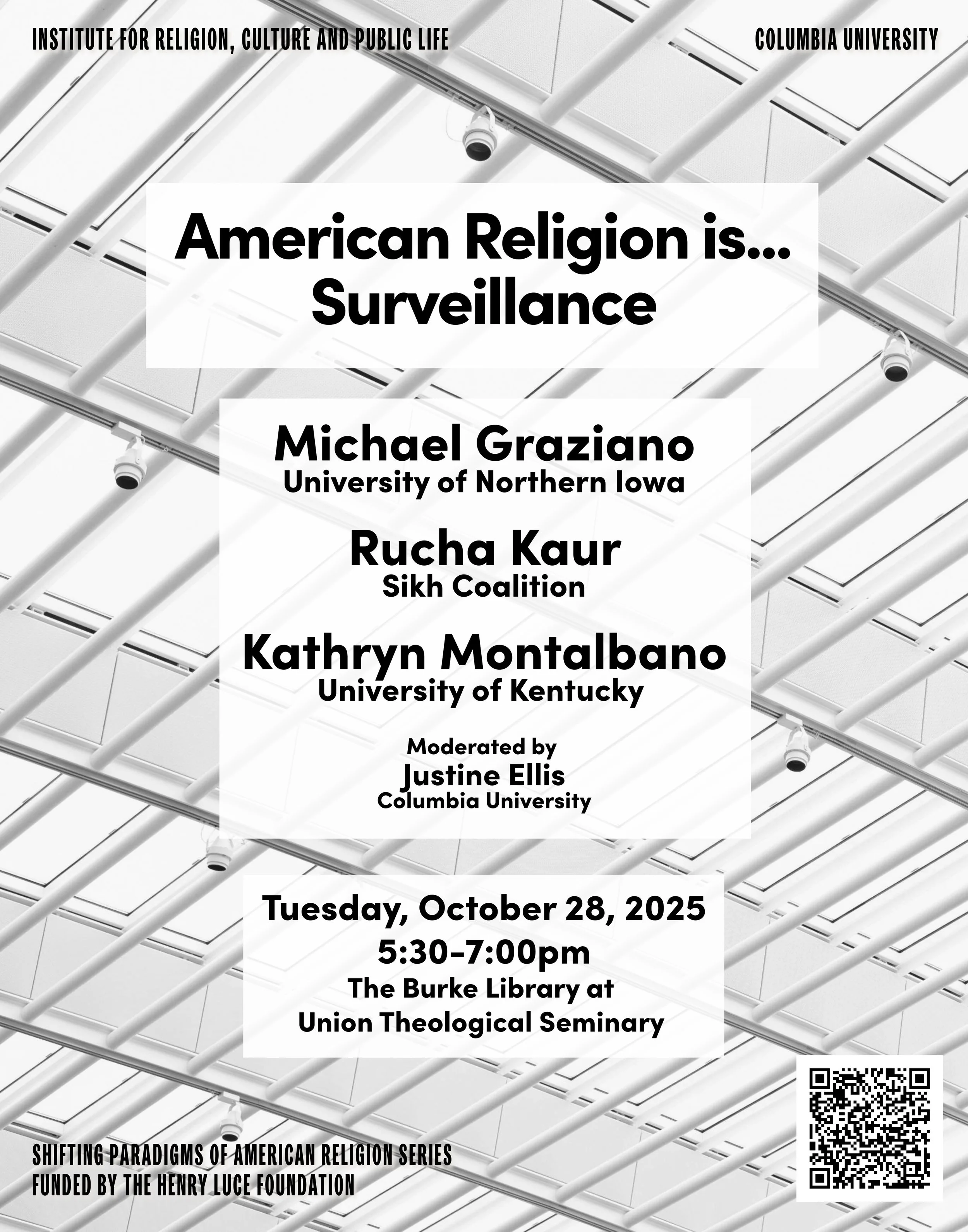
American Religion is…Surveillance

  • Burke Library at Union Theological Seminary (map)
  • Google Calendar ICS

From a keystroke to a commute, our seemingly private, and innocuous, actions rarely remain unobserved. Emerging digital technologies, changing forms of media, and new configurations of public spaces have made many aspects of our daily lives hyper-visible. American religious communities are no strangers to such visibility, with a long histories of entanglement with law enforcement and securitization, including as targets of surveillance or as requesters of increased monitoring to protect gathering spaces. IRCPL’s “American Religion is…Surveillance” helps us think together about what it means to watch, to be watched, and to witness, in our present moment.

View Event →
What was Pious Attention?
Oct
17
12:15 PM12:15

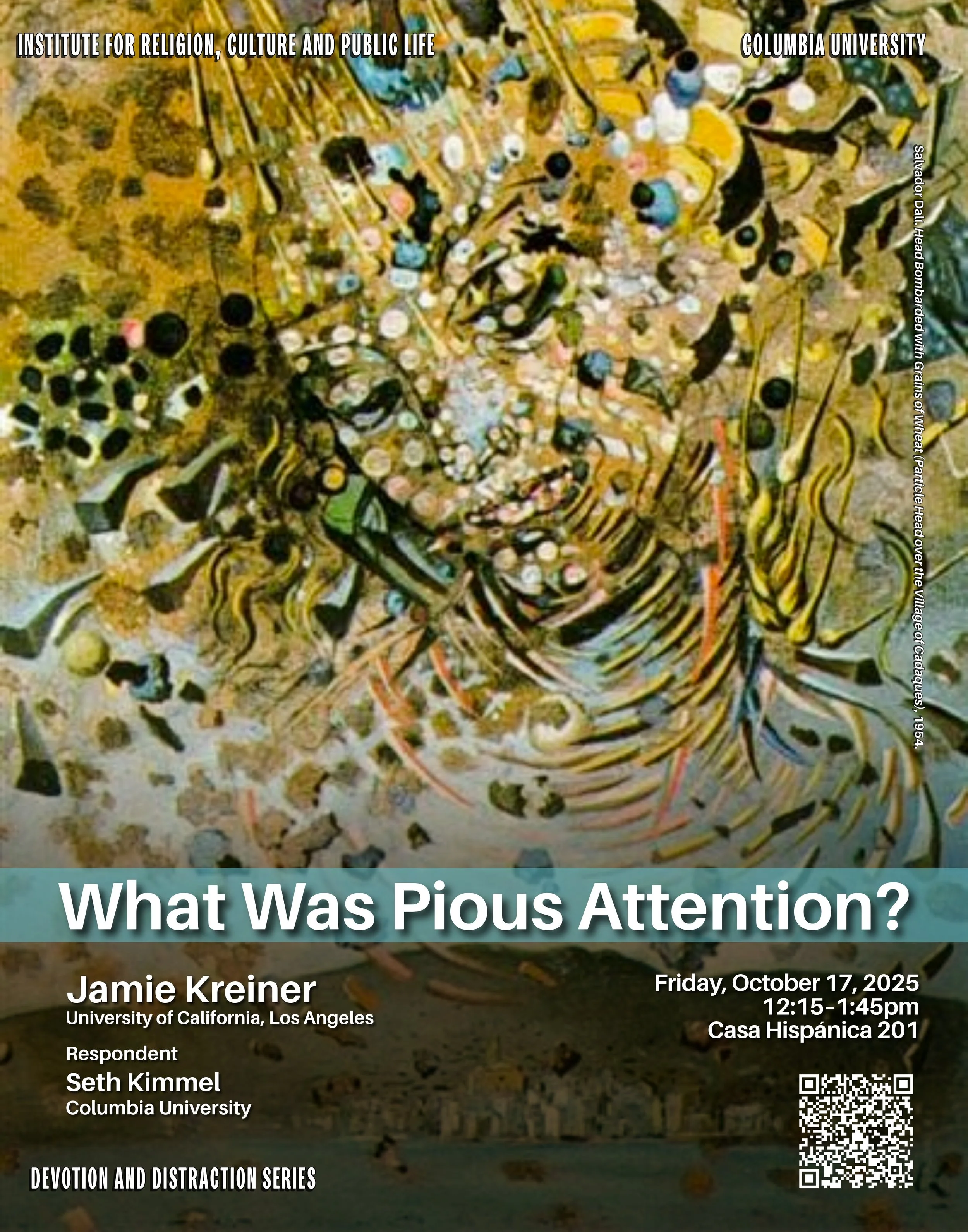
What was Pious Attention?

  • 612 West 116th Street New York, NY, 10027 United States (map)
  • Google Calendar ICS

We tend to think of the problem of paying attention while being bombarded with an overwhelming quantity and variety of information and seduced by ever more invasive forms of distraction as a uniquely contemporary one. But medieval monks, pious early modern poets, and others from the past developed strategies to focus during what they perceived as their own moments of distraction or information overload. What were the pious practices of attention that these medieval and early modern Christians cultivated? How might better understanding these practices from the past help us to think critically about focus and distraction today in both sacred and secular contexts?

View Event →