Events
Events Archive
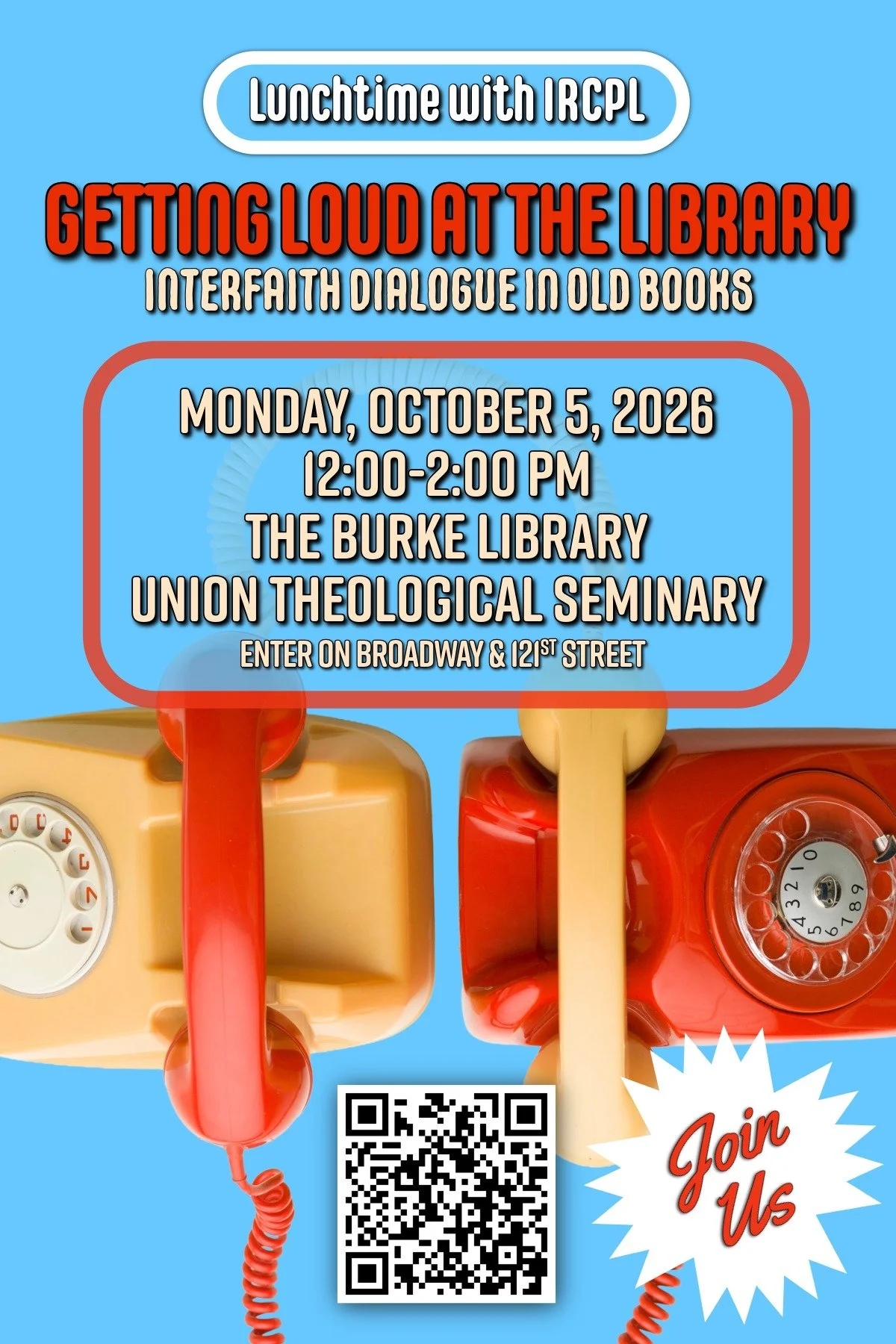
Who says you can't talk in the library? Just as you gather in Butler or Burke Library with friends and acquaintances to talk about books, debate ideas, work on your research, and even just hang out, so too did bookish people of the past.
The library has always been a meeting place for people from distinct religious communities. They often spoke different languages, and they generally disagreed about many things. But they engaged in dialogue. How, exactly? And why?
Come join IRCPL Director Seth Kimmel and Burke Library's Collection Services Librarian Jeffrey Wayno to explore some rare books and manuscripts that tell the stories of these encounters, and stay for the free lunch!
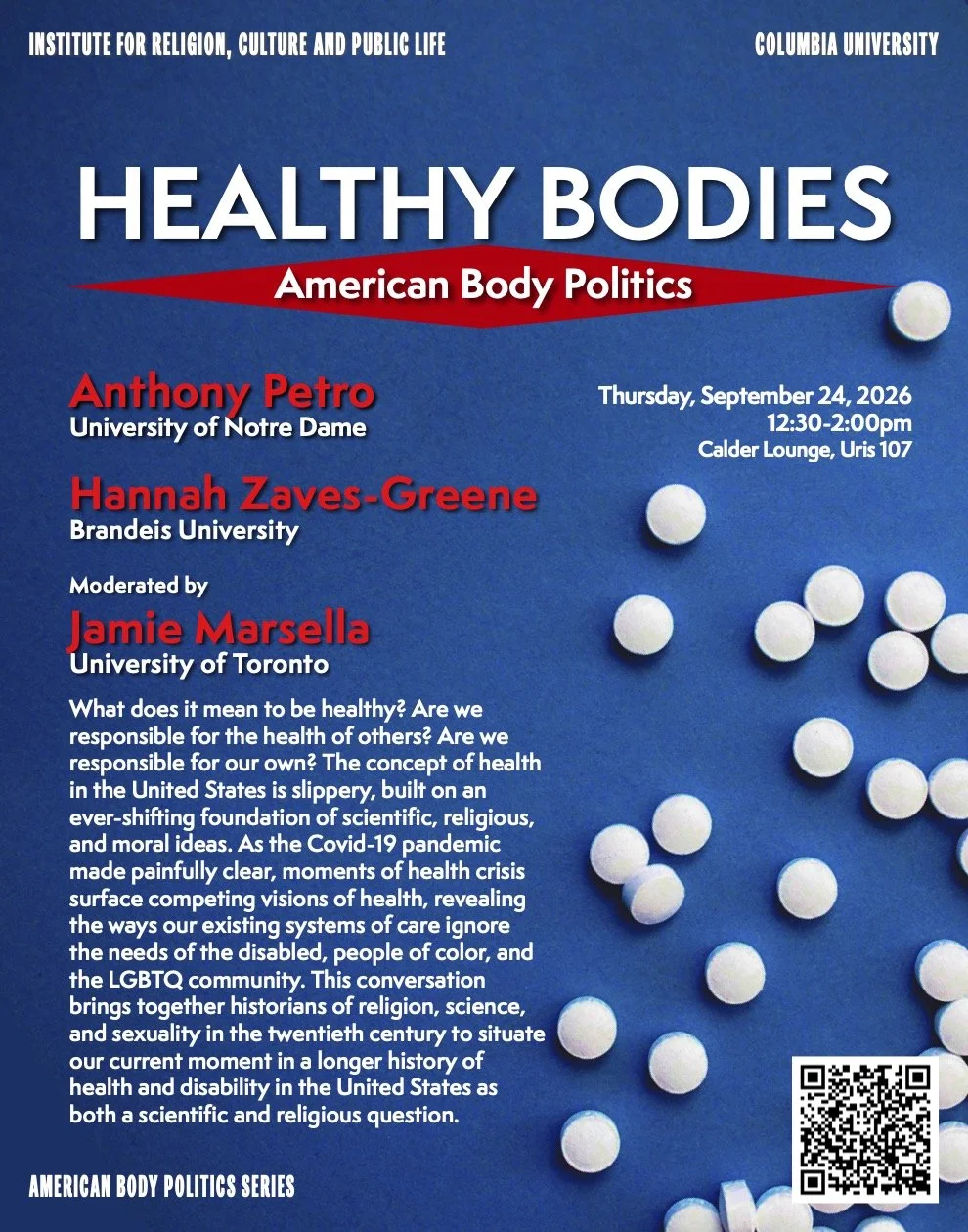
What does it mean to be healthy? Are we responsible for the health of others? Are we responsible for our own? The concept of health in the United States is slippery, built on an ever-shifting foundation of scientific, religious, and moral ideas. As the Covid-19 pandemic made painfully clear, moments of health crisis surface competing visions of health, revealing the ways our existing systems of care ignore the needs of the disabled, people of color, and the LGBTQ community. This conversation brings together historians of religion, science, and sexuality in the twentieth century to situate our current moment in a longer history of health and disability in the United States as both a scientific and religious question.

Attention is a valuable commodity. The capacity not only to keep distractions at bay, but also actively to pay attention to particular people, works of art, ideals, and politics is in constant tension with the attention claimed by mass media, consumption, and the wired ecosystem of our daily lives more broadly. Drawing into the present our year-long exploration of the relationship between devotion and distraction at various moments in the past, this final panel discussion turns to the places occupied by spirituality, self-help, and various other types of subject formation within the contemporary attention economy. Contemporary seekers are experimenting with strategies to counter distraction while at the same time competing for the time and attention of like-minded people who also desire deeper meaning and balance in their lives. What are these strategies and the coalitions in which they take shape? What do they share with attention techniques of the past? How have the dramatic technological and social changes of the last few years reshaped both the attention economy and the ways that we imagine ourselves as ethical and engaged individuals?
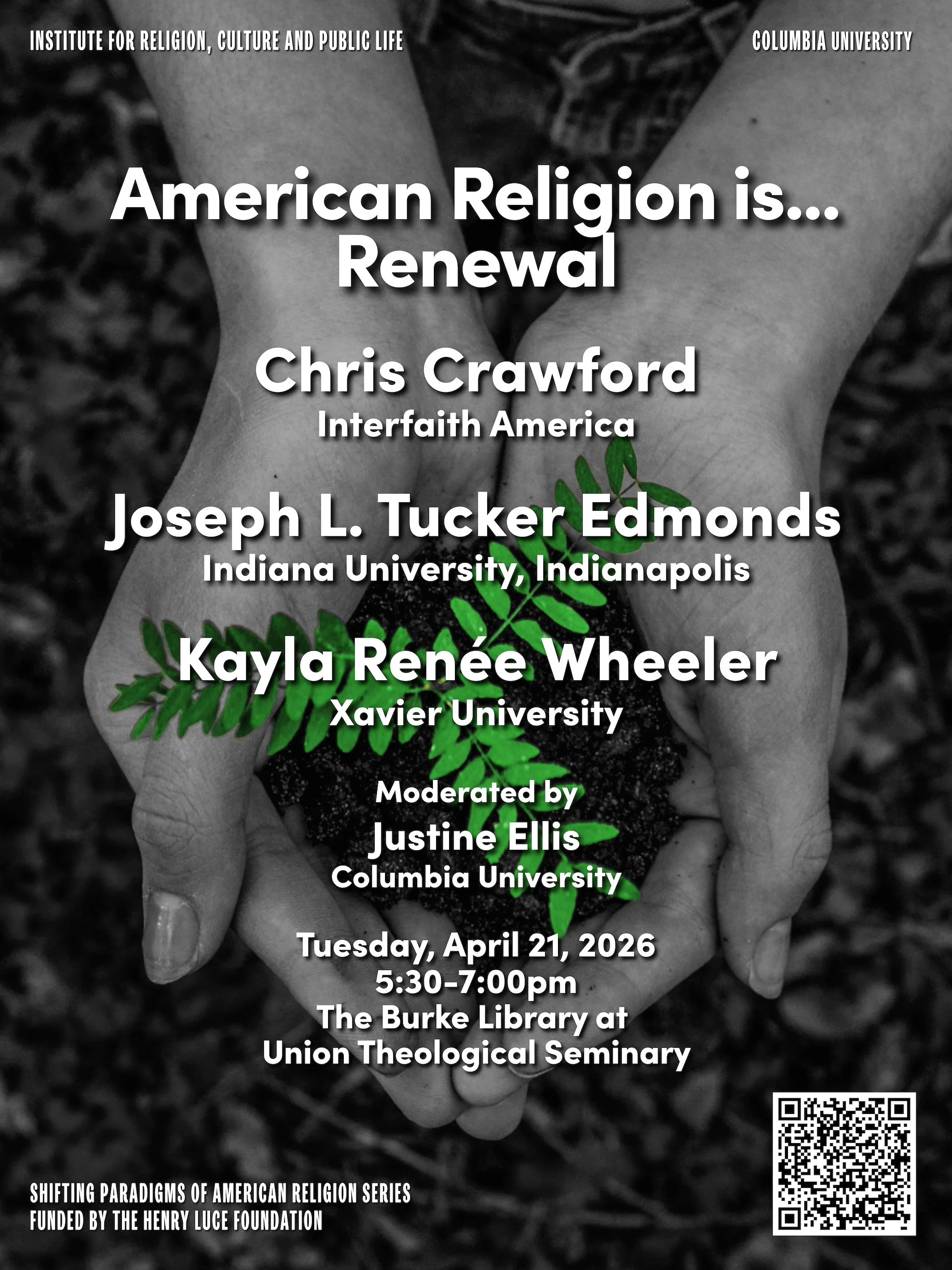
Our national conversation remains divided: does religion advance civic causes and community based action or serve as a source of social difference and potential disruption? But the idea that religion either helps or hurts our civic life doesn’t capture the full picture. How can we push past hero-villain narratives to consider the ways religious forms and communities shape and share knowledge. Join IRCPL for a conversation with scholars and policymakers as we think together about the positives and the perils of viewing religion as a resource.
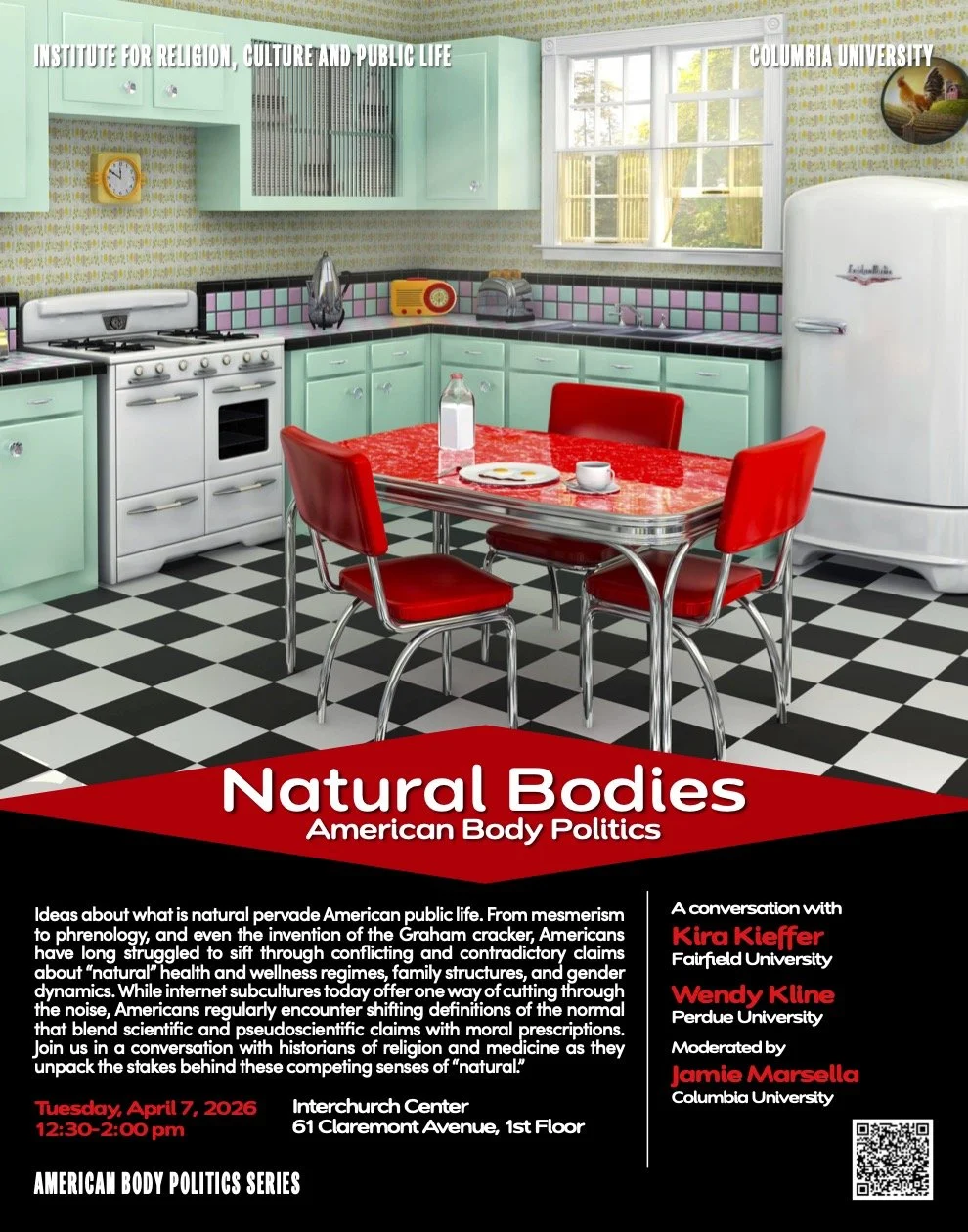
Ideas about what is natural pervade American public life. From mesmerism to phrenology, and even the invention of the Graham cracker, Americans have long struggled to sift through conflicting and contradictory claims about “natural” health and wellness regimes, family structures, and gender dynamics. While internet subcultures today offer one way of cutting through the noise, Americans regularly encounter shifting definitions of the normal that blend scientific and pseudoscientific claims with moral prescriptions. Join us in a conversation with historians of religion and medicine as they unpack the stakes behind these competing senses of “natural.”
What imprint do we leave behind on physical and digital landscapes? From monuments to museums, and from rituals to remembrance, perspectives from the study of American religion can help us understand the narratives we tell ourselves about the present. Join IRCPL for a conversation about the public stakes of preservation and erasure in our current moment.
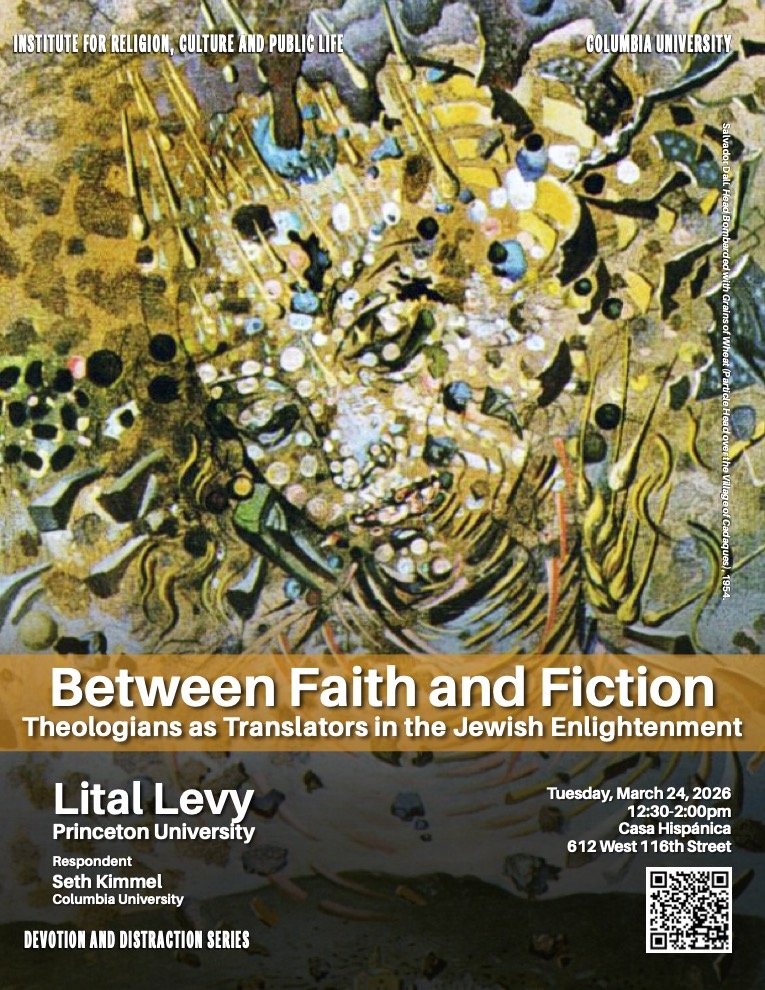
In a simple story that we now tell ourselves about secularization, the European Enlightenment plays a key role: It’s the period when scientific inquiry and rational thought became ascendent, while religious practice receded to a more limited private sphere, a shift that coincided with new paradigms of toleration and liberty. The truth is of course more complicated, as theologians from various religious communities reimagined both religious practice and belief in dialogue with the philosophical and political trends of the moment. Along with their neighbors from other religious communities, how did participants in the Jewish Enlightenment, or Haskalah, come to view the new distractions, technological transformations, and dream of universal knowledge that characterized modern life before the eighteenth and nineteenth centuries?

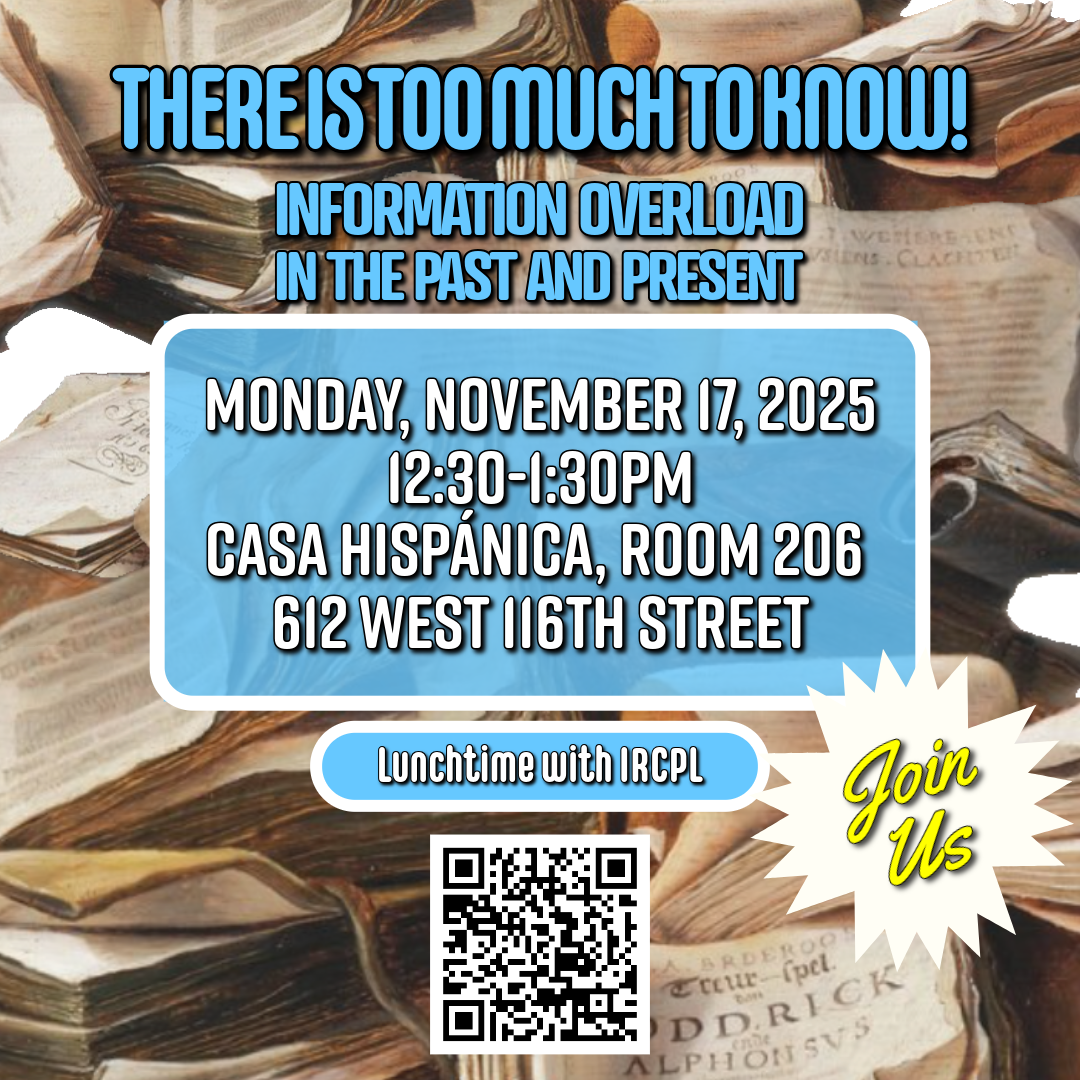
With the sense of possibility occasioned by each new technology of the written word, the aspiration to know all that there is to know takes on new life. But even as the printing press or the e-book have at the moment of their invention promised to increase access, they also have led to an exponential increase in new texts. Moreover, although strategies of information management have shifted over time, the feeling of information overload is recurrent and transhistorical. It certainly is not unique to the age of print culture or the internet era. Medieval and early modern Islamic scholars, working with manuscripts and pursuing research across a range of interrelated encyclopedic genres, honed myriad techniques for organizing and retrieving knowledge. How might we weave together these histories of information management and the religious sciences?
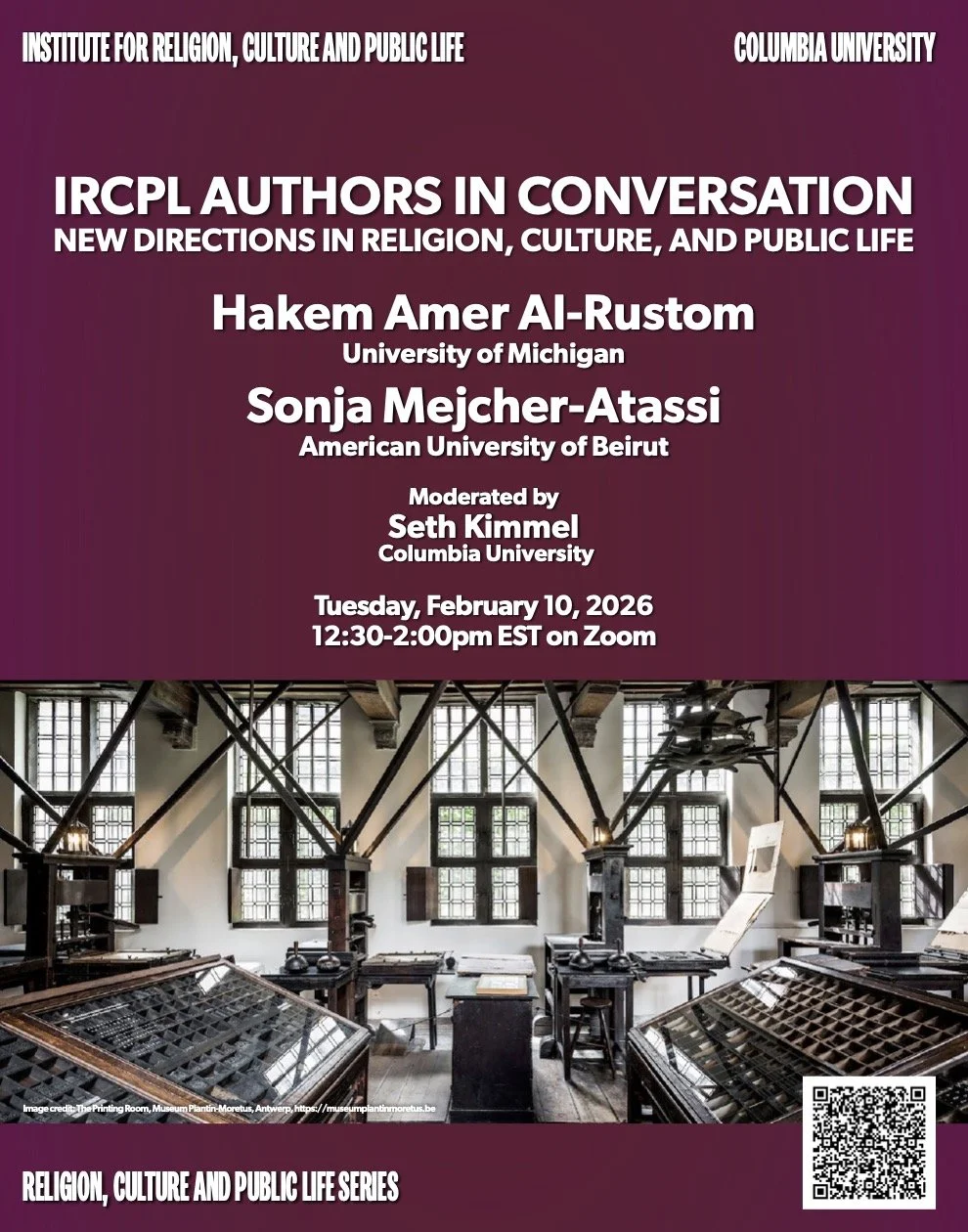
Topics at the intersection of religion, culture, and public life have taken on special urgency in our current moment of social and political upheaval. Join us for an online conversation with recent IRCPL list authors to reflect on what scholarship has looked like in recent years, and to think together about where it could or should head in the future.
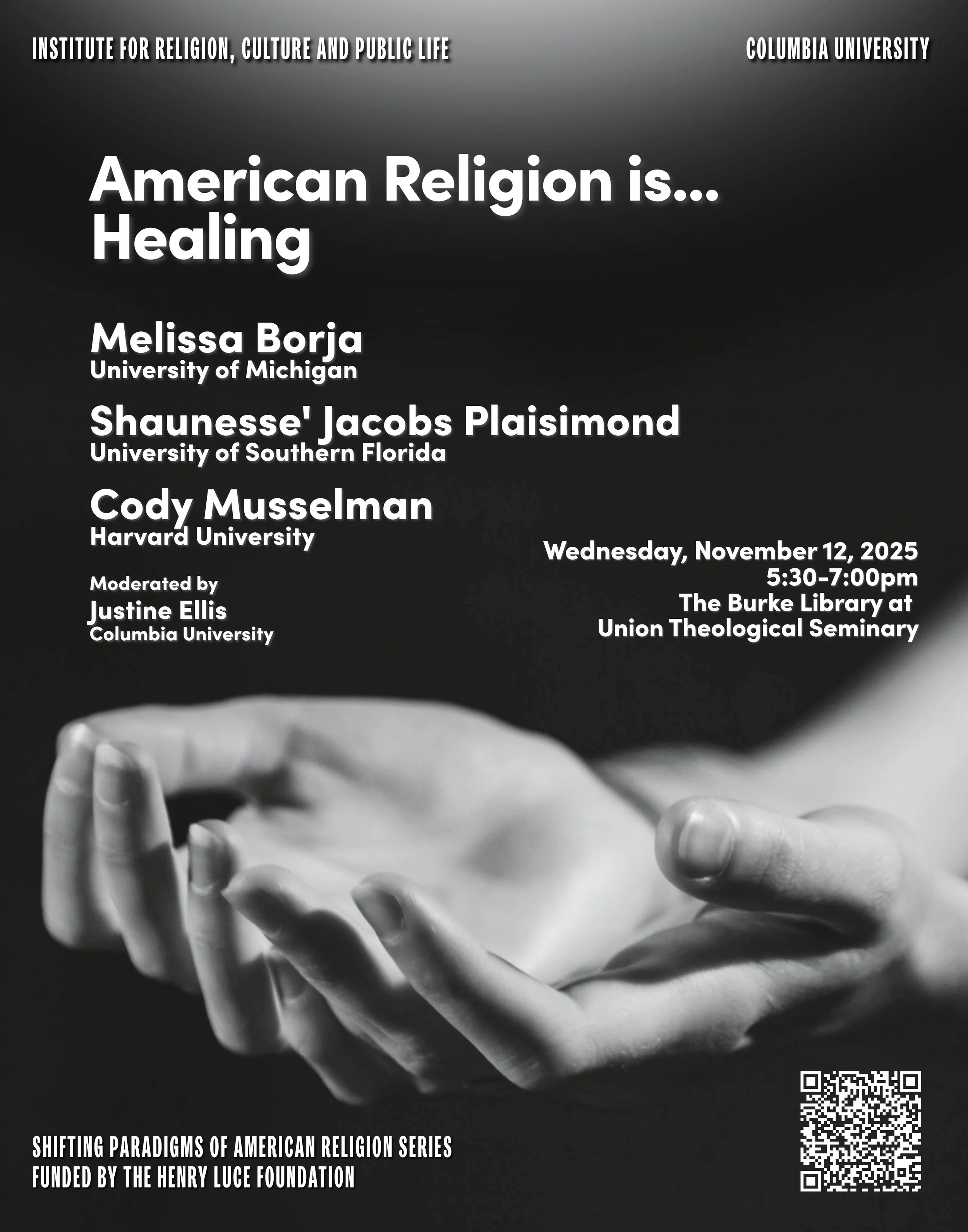
When it comes to health and wellness, Americans are divided on whether religion is healing or harming. Recent years have shown how our bodies can become sites of vulnerability and contestation, but do our religious identities and communities serve as sources of dignity and individual autonomy or as barriers to access and accurate information? The “American Religion is…Healing” program offers new perspectives on how we can move past this kind of binary thinking, focusing instead on how ideas about religion and spirituality shape not only American public health approaches, but also the information we classify as credible or conspiracist. Join us for a conversation about what it means to feel well and to live well in precarious times.

Topics at the intersection of religion, culture, and public life have taken on special urgency in our current moment of social and political upheaval. Join us for an online conversation with recent IRCPL list authors to reflect on what scholarship has looked like in recent years, and to think together about where it could or should head in the future.
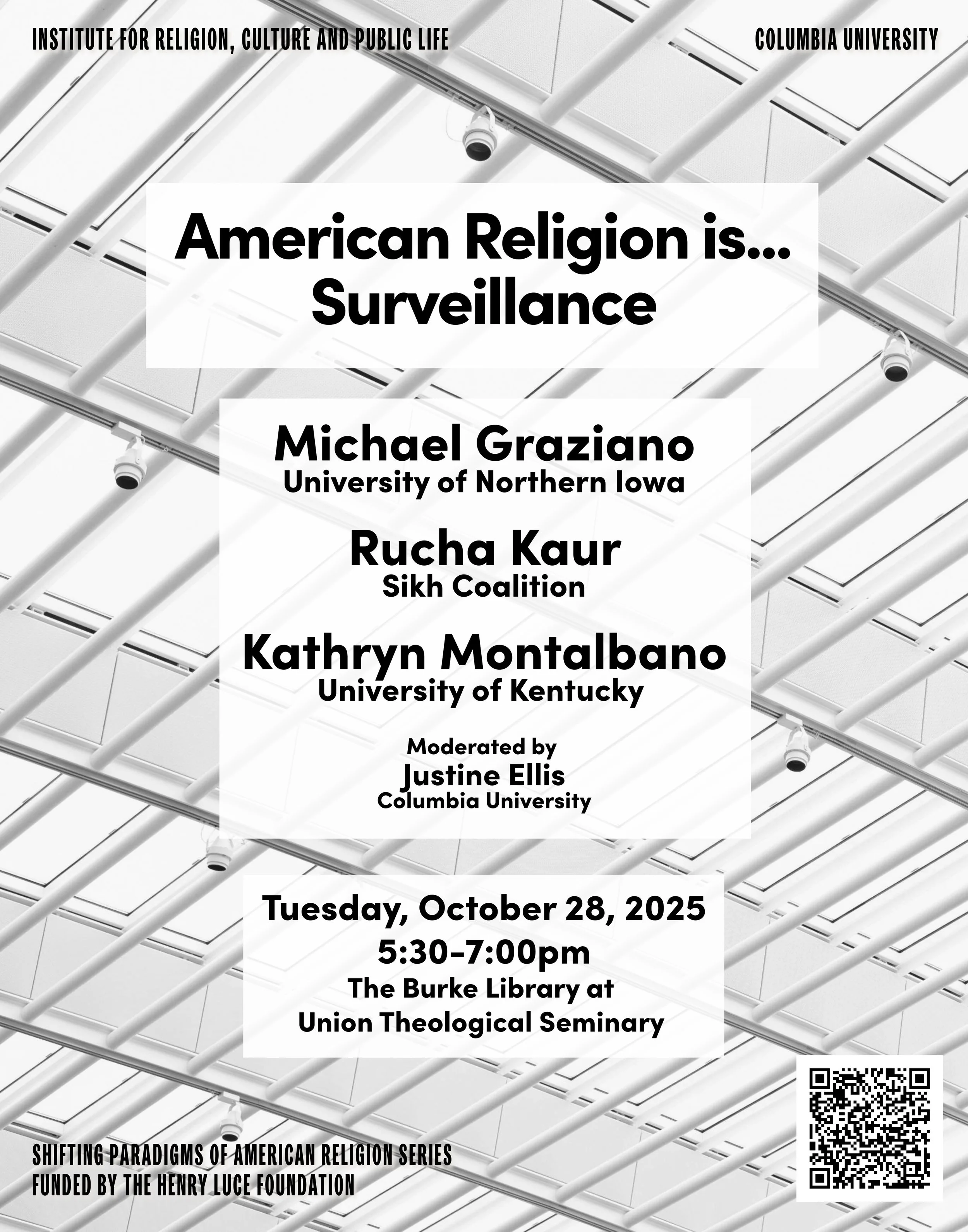
From a keystroke to a commute, our seemingly private, and innocuous, actions rarely remain unobserved. Emerging digital technologies, changing forms of media, and new configurations of public spaces have made many aspects of our daily lives hyper-visible. American religious communities are no strangers to such visibility, with a long histories of entanglement with law enforcement and securitization, including as targets of surveillance or as requesters of increased monitoring to protect gathering spaces. IRCPL’s “American Religion is…Surveillance” helps us think together about what it means to watch, to be watched, and to witness, in our present moment.
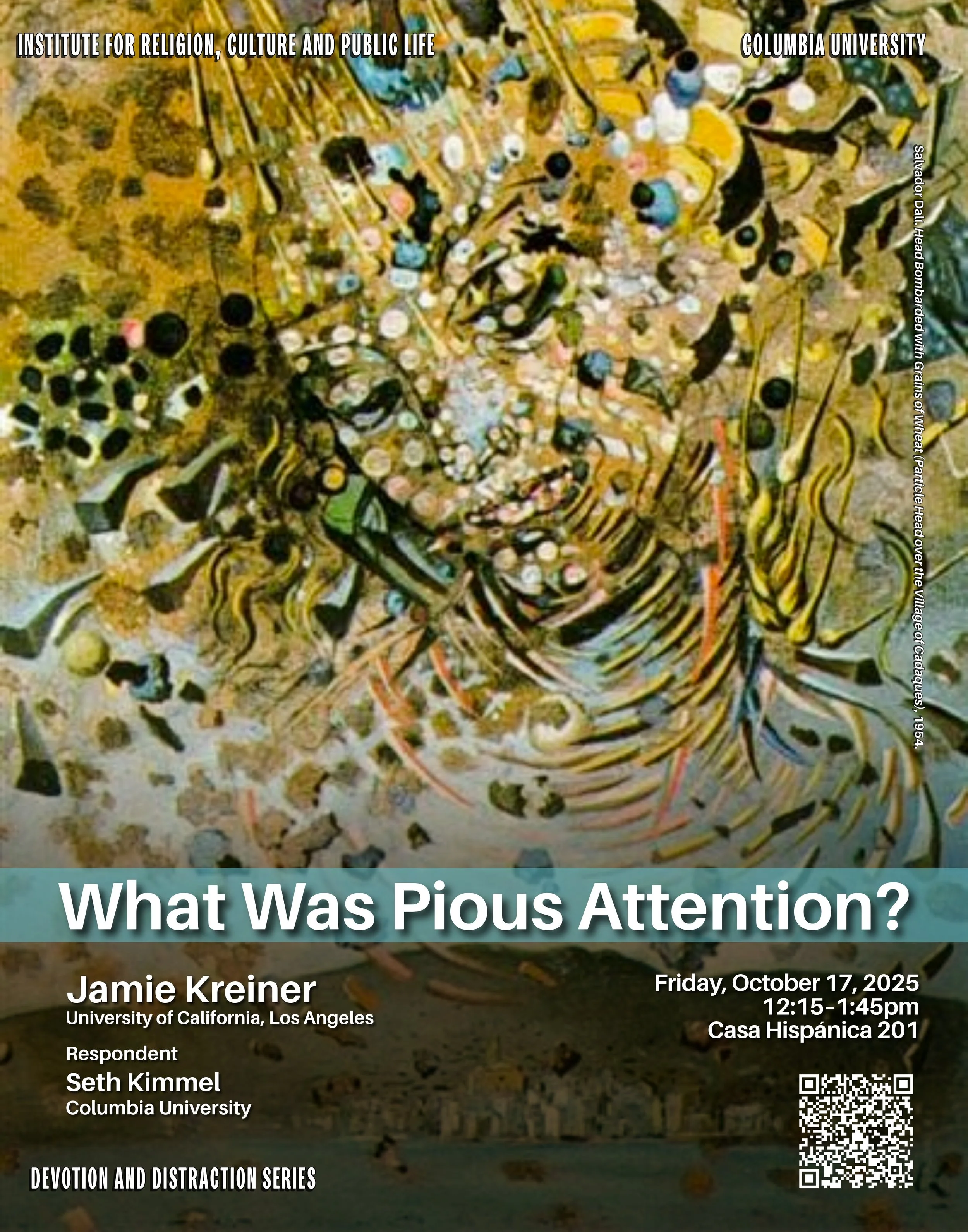
We tend to think of the problem of paying attention while being bombarded with an overwhelming quantity and variety of information and seduced by ever more invasive forms of distraction as a uniquely contemporary one. But medieval monks, pious early modern poets, and others from the past developed strategies to focus during what they perceived as their own moments of distraction or information overload. What were the pious practices of attention that these medieval and early modern Christians cultivated? How might better understanding these practices from the past help us to think critically about focus and distraction today in both sacred and secular contexts?
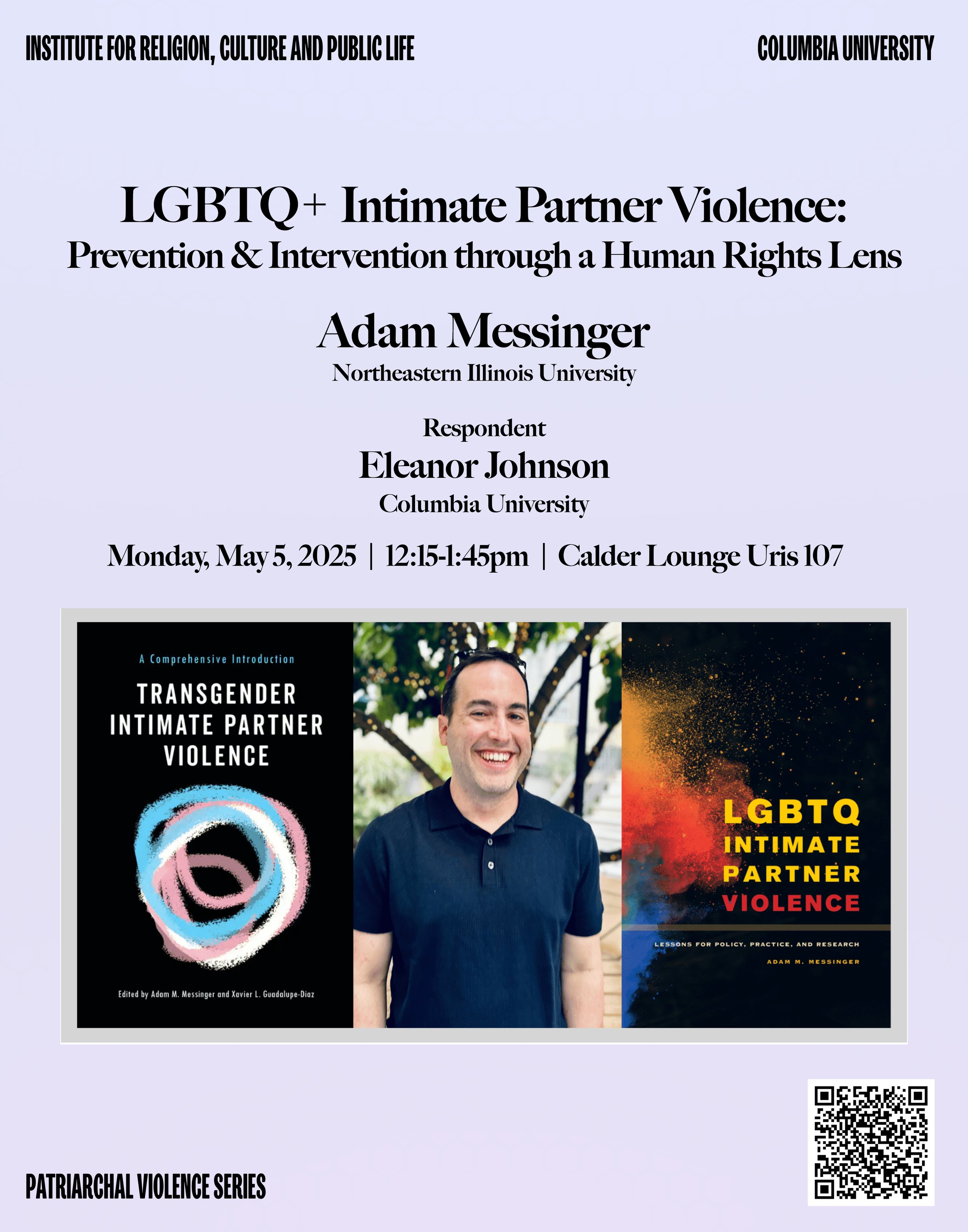
In our current moment in the United States, the human rights of lesbian, gay, bisexual, transgender, and queer (LGBTQ+) people are under threat. For LGBTQ+ survivors of relationship abuse or “intimate partner violence” (IPV), the erosion of human rights is unfortunately linked to IPV prevalence and dynamics, as well as to barriers to safety. You are invited to a talk on these important issues by researcher Dr. Adam Messinger, author of LGBTQ Intimate Partner Violence: Lessons for Policy, Practice, & Research (2017, UC Press) and co-editor of Transgender Intimate Partner Violence: A Comprehensive Introduction (2020, NYU Press). Come learn how, together, we can build a more inclusive, compassionate future for trans and queer survivors of abuse
From competing claims over authenticity to solidarities forged among neighbors, the notion of “the local” has long been a site of contestation, collaboration, and frankly, confusion. In a time of increasing boundary drawing, it is more urgent than ever to consider what we mean, enable, and foreclose when using the term local in relation to religion. This gathering brings together participants to consider the infrastructures—the relationships and resources—that shape local religious forms and engagement with communities in our own neighborhoods. Join IRCPL for a conversation with scholars and policy practitioners about building community based knowledge, and equitable and effective partnerships.

The talk provides an overview of the problematic history of police response to survivors’ desperate calls for protection and assistance and the role of survivors and their allies in advancing reforms in New York State and nationally to improve law enforcement’s response to domestic violence. The three speakers will explore the systemic impunity conferred on perpetrators of intimate partner violence by legal regimes over centuries; the role of the domestic violence survivors’ advocacy movement in challenging this state of affairs; highly publicized legal cases of police failure to protect that galvanized the movement; the arguments it advanced in support of new policies; and critical analysis of these policies and some unintended consequences that precipitated a new set of policy reforms. The talk concludes with an assessment of current conditions experienced by domestic violence survivors and the extent to which New York State’s laws curtailing police discretion remain responsive to their needs for protection and justice.

“Ancestor worship” is a classic category of analysis in religious studies, one that has come to be taken for granted in both academic writing and public discourse as a minoritarian form of religious practice. This talk examines the complexities of imposing the frame of religion on ancestors by examining the relational dimensions of ancestral practices in Zimbabwe that also raise questions about kinship. Drawing on missionary, colonial, and ethnographic archives, the talk interrogates how ancestral practices came to be a minoritized form of “religion” over the past two centuries. In the precolonial world, ancestral spirits were fundamental to local knowledge systems, played a central role in everyday life, and formed the bedrock of social and political power. The talk traces how British colonists worked to demonize, marginalize and ultimately minoritize ancestors in Zimbabwe, configuring them first as “superstition” and later a kind of religion that would become a minority form of religious practice. Ultimately, the talk argues that these processes transformed ancestors into a minority “religion” while erasing their relational dimensions, a struggle that played out in many contexts and continues to limit understandings of ancestors and ancestral practices. At the same time, the talk makes the case for a relational approach to ancestral spirits by examining how people in Zimbabwe continue to imagine, resist, and rework the meanings of both ancestors and religion. This talk draws on material from Raffaella Taylor-Seymour’s book project, titled Ancestral Intimacies: Queerness, Relationality and Religion in Zimbabwe.
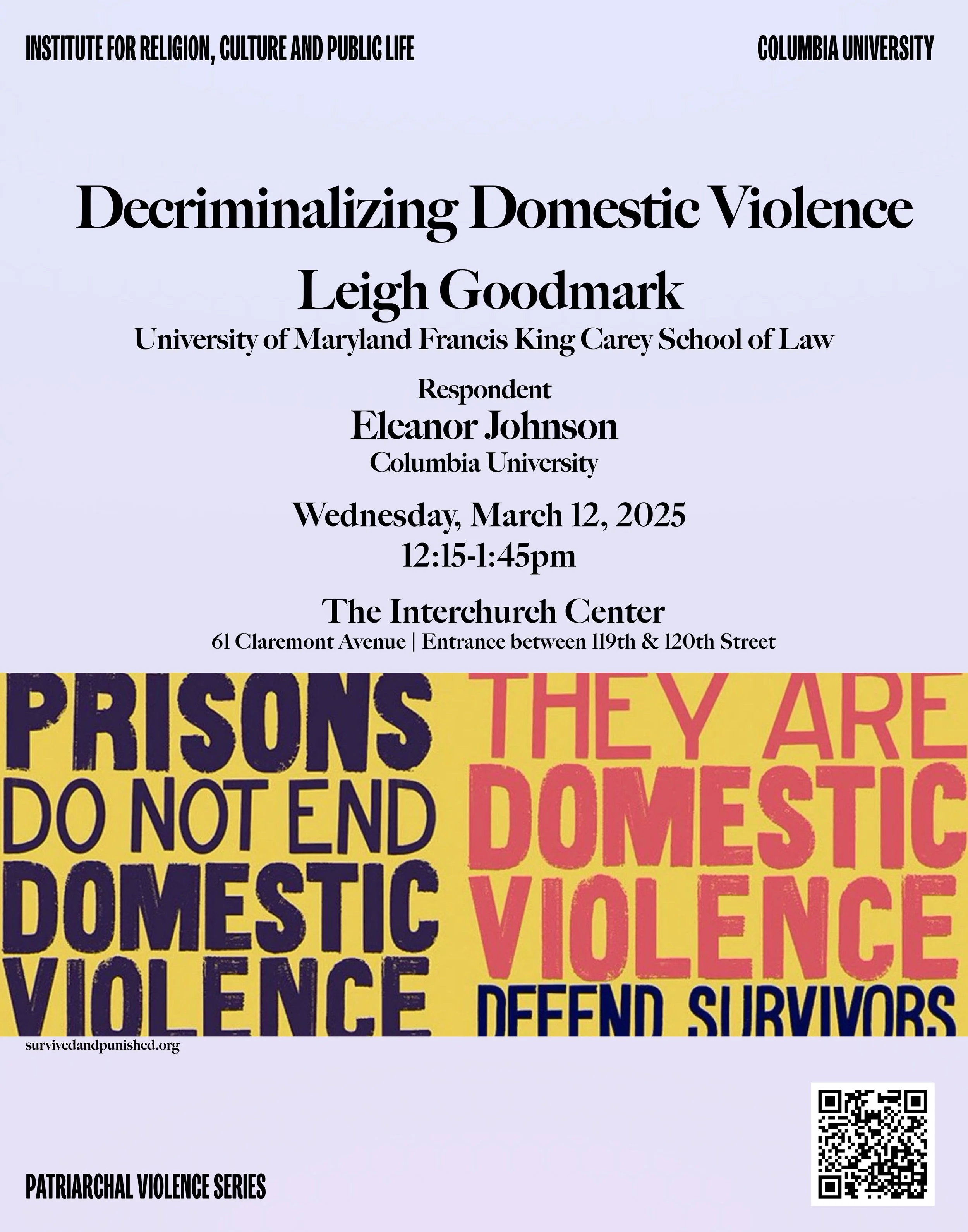
For more than forty years, criminalization has been the primary approach to addressing intimate partner violence in the United States. Intent on ensuring that intimate partner violence was treated like any other crime, anti-violence feminists campaigned for stronger enforcement of the criminal law against those accused of violence. Bolstered by billions of dollars in federal funding, states have enacted laws and policies mandating arrest and prosecution in cases involving domestic violence and increasing sentences for crimes of violence. But criminalization has not decreased or deterred intimate partner violence. Instead, criminalization exacerbates the correlates of intimate partner violence and has serious consequences for the people that it was meant to help. This talk will argue that we should shift our policy responses to intimate partner violence away from criminalization and instead look at the problem through the lenses of economics, public health, and community intervention.

What if the selfish gene theory is actually a poor model of human reproduction? Female mammals’ sex organs seem to spend most of their time avoiding fertilization, not the other way around—which can give us better directions in women’s health research and a better way of telling the story of the female body. (Spoiler alert: it might also save male lives, too.)

IRCPL’s Religion and Climate series is animated by calls to reimagine human relationships with and responsibilities to the environment in an age of planetary crisis. As the impact of climate change is increasingly but unevenly felt, religion is emerging as a site of epistemological doubt, struggle, and possibility. This series explores the cosmological underpinnings that shape diverse understandings of the environment and examine how religious subjects react to and act upon the ecological upheavals they face, challenging exclusively technocratic and secular responses to the climate crisis.
The series involves four events structured around the elements—Earth, Water, Fire, and Air—each of which will take one element as a lens for engaging with specific climate struggles and the religious debates they ignite. In the final event, an online program on the theme of “Air,” Sophie Chao (University of Sydney) and Nikita Simpson (SOAS, University of London) will discuss their work on climate change, atmospherics and spirits in West Papua, India, and the U.K. This conversation will explore both the religious dimensions of air and atmospheres in these contexts, and the ways contemporary climate change emerges out of longer histories of environmental destruction.
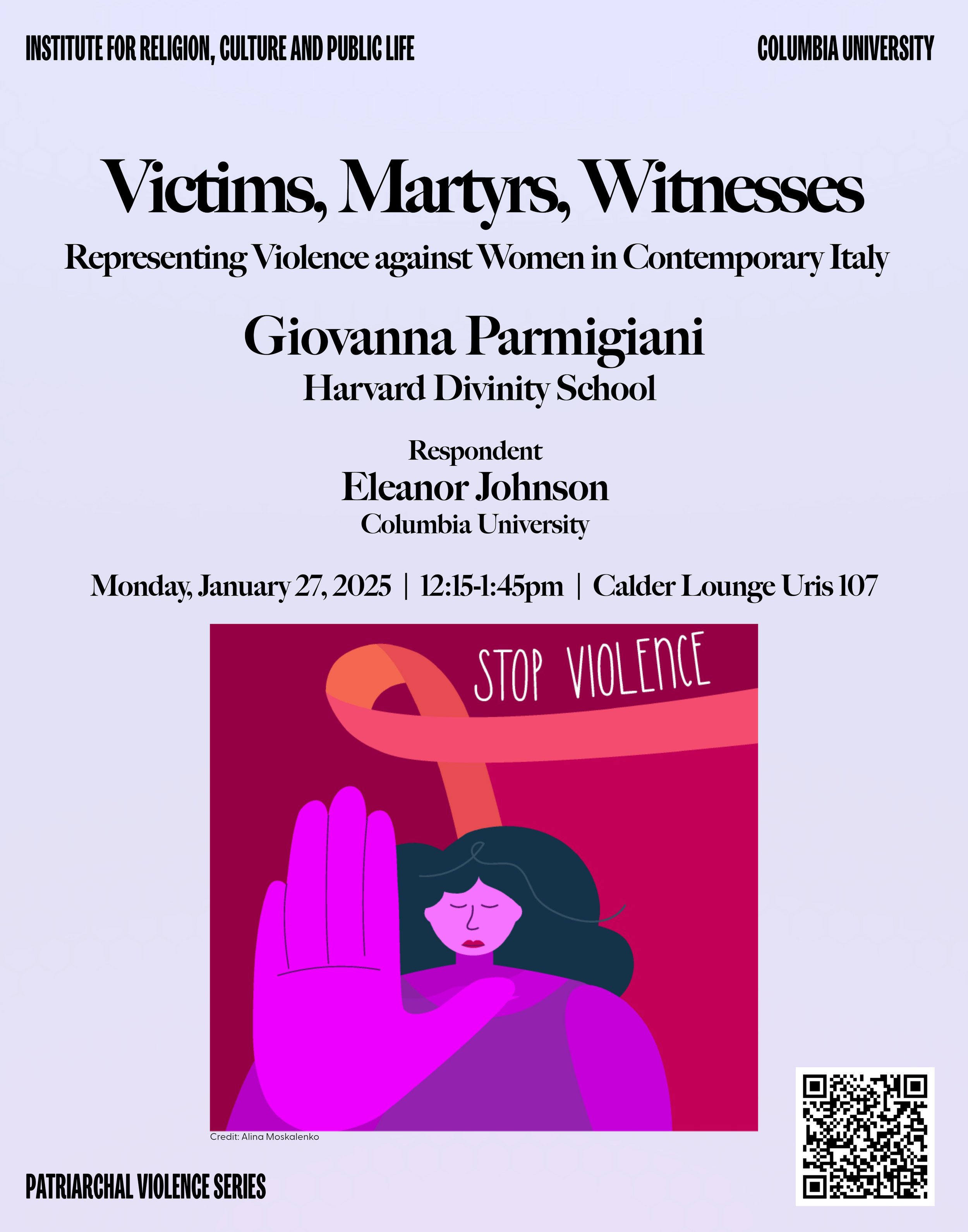
In this talk, based on extensive ethnographic research in Italy, Dr. Parmigiani will focus on representations of women and gender-based violence in contemporary Italy. She will describe and analyze the politics of representation enacted by the Italian feminists of UDI (Unione delle Donne in Italia), the oldest Italian feminist group, in the context of the pervasive representations of women as victims portrayed by the Italian media, Catholic pro-life movements, and hegemonic patriarchal discourses. By analyzing UDI's motto “'We are witnesses, not victims," she will address the strengths and weaknesses of the "ethos of survivorship" and suggest other possible empowering ways to reframe discourses and representations around women and violence, in Italy and elsewhere.

Obstetric violence is characterized by medical neglect, unconsented intervention, and demeaning treatment of pregnant and birthing people. It is a particular, and particularly gendered, form of institutional and social violence that both stems from, and exacerbates, other oppressions and vulnerabilities. For example, obstetric racism is one form of obstetric violence that partially accounts for the unacceptably high rate of maternal mortality among Black, Latino, and Indigenous women in the United States. This talk will place Mexico within a transnational history of obstetric violence. It offers a new genealogy of the concept, beginning with the priest-surgeons of Spain’s late Bourbon empire, during which time the Spanish Crown declared that the spiritual life of an embryo was of greater importance than the corporeal life of its mother. Moving throughout scientific racism in the nineteenth century and to eugenics in the early twentieth century, the talk explores how Catholic theology affected— and was affected by—developments in maternal/fetal science. Even during periods of Church-state conflict, the religious valences of experimental surgery manifested in embodied expressions of racialized, and often-coercive, medical science. Examining this history underscores the long history, and persistent legacy, of religious prerogatives in the provenance of reproductive healthcare.

Cattin, a teenaged enslaved girl brought to France by her enslaver in 1746, experienced extraordinary levels of physical abuse during her seven month stay. This talk explores her world through a micro-microhistory that examines the intersections of Catholicism, slavery, and intimate violence in Nantes, France’s largest slave port. As Cattin pursued fugitivity, her interactions with enslavers, priests, nuns, Hôtel-Dieu bureaucrats and godparents as well as free Black and enslaved women shaped her experiences of intimate violence and communities of care in a Catholic city immersed in racial capitalism.

IRCPL’s Religion and Climate series is animated by calls to reimagine human relationships with and responsibilities to the environment in an age of planetary crisis. As the impact of climate change is increasingly but unevenly felt, religion is emerging as a site of epistemological doubt, struggle, and possibility. This series will explore the cosmological underpinnings that shape diverse understandings of the environment and examine how religious subjects react to and act upon the ecological upheavals they face, challenging exclusively technocratic or secular responses to the climate crisis. The series will begin with four events structured around the elements—Earth, Fire, Water, and Air—each of which will take one element as a lens for engaging with specific climate struggles and the religious debates they ignite. In the next event, an online program on the theme of “Fire,” Adriana Petryna (University of Pennsylvania) and Mareike Winchell (London School of Economics and Political Science) will discuss their work on wildfires in the United States and Bolivia, exploring both the political-theological dimensions of fire and complexities of taking action to prevent environmental disasters.

Years after critiques of the understanding of religions as texts to be interpreted, decoded, or translated, the notion of religion as belief-based still looms large in public discussion, teaching about religion, and policymaking. What are the remaining implications for the study of religion in our classrooms and civic spaces? In what ways are narratives, dispositions, bodily practices, and material culture overlooked—and with what consequences for American religion? Join IRCPL for a conversation with scholars and policy practitioners about the pitfalls and possibilities of understanding the category of religion in terms of belief.

American responses to the rise of AI have been mixed: is Artificial Intelligence our friend, or our foe? Hope for the future, or our undoing? IRCPL's "American Religion is…Human" program offers new ways of thinking about AI, humanity, and religion, going past the utopian-dystopian binaries that our public discourse is stuck in. We will think together about how the rise of potentially destabilizing AI technology might intersect productively with current efforts to rethink humanistic pedagogy and scholarship. Join IRCPL as we interrogate assumptions about religion’s “human-ness” and considerations of hierarchy and supremacy raised by the notion of religion as an innately human concept.

Islamophobia has posed a serious threat to religious freedom and human rights in the Xinjiang Autonomous Region of China. This event will bring together experts and civil society leaders to explore effective strategies and foster international collaboration in combating Islamophobia. The goal is to serve as a catalyst for change, inspiring a region-wide commitment to protecting the dignity and rights of Muslim communities.

IRCPL’s Religion and Climate series is animated by calls to reimagine human relationships with and responsibilities to the environment in an age of planetary crisis. As the impact of climate change is increasingly but unevenly felt, religion is emerging as a site of epistemological doubt, struggle, and possibility. This series will explore the cosmological underpinnings that shape diverse understandings of the environment and examine how religious subjects react to and act upon the ecological upheavals they face, challenging exclusively technocratic or secular responses to the climate crisis. The series consists of four events structured around the elements—Earth, Water, Fire, and Air—each of which takes one element as a lens for engaging with specific climate struggles and the religious debates they ignite. Join IRCPL for an in-person conversation on the theme of “Water” with Naveeda Khan (Anthropology, Johns Hopkins University) and Jinah Kim (History of Art and Architecture, Harvard University), who will discuss their work on water, riverine ecosystems, and religion in South Asia. The conversation will explore cosmologies of water, religious struggles taking place around rivers, and the complexities of taking action to prevent environmental destruction. The event will be introduced and moderated by Raffaella Taylor-Seymour (IRCPL, Columbia University).

Patriarchal violence in the home has a long and profoundly troubling history. Recent and contemporary American law and culture have made great strides in identifying and responding to acts of violence in the home. But progress has been slow, and slowing down in the face of new mechanisms and technologies of abuse. In order to understand and respond to current modes and forms of domestic violence, we need to look back—way back to the English Middle Ages—to see the practical and ideological origins of domestic violence. Getting into the core religious and social beliefs that medieval people held about women's rights to autonomy and safety in the home sheds an uncomfortable but important light on social values and jurisprudence since the 1960s.

How does Kafka’s “cynical” story, Researches of a Dog, intersect with Shakespeare’s sad stories of the death of kings? How does each author locate a kind of freedom at the point of a missing link in the constitution of the world presented in each text, a point where the sovereign and the creature encounter one another in, to use Paul Celan’s phrase, the majesty of the absurd?

Astrology is everywhere these days. In our digital age, astrological symbols and concepts have never been more popular, or as diverse in their applications. As ancient divination practices are being actively revived and synthesized with elements of modern philosophy, astronomy, psychology, and alternative spirituality, we are compelled to ask: What does it mean to reproduce classical meanings and metaphysics in modern contexts? How do occult traditions of the past align with contemporary social ethics and values? This panel brings three professional astrologers in conversation with a cultural anthropologist to discuss the growing popularity of astrology, considering these and other questions. We will examine the “timeless” nature of astrology while also asking if there are limits to the universality of ancient knowledge systems.

What can Palestine teach us about the global history of race, capital, slavery, and dispossession? What is the relationship between land and colonialism? Moving beyond paradigms of exceptionalism and the confines of the nation-state reveals Palestine as a key site to explore these questions. Tracing the struggle on and over land, this talk reflects on Palestine’s lessons in and with the movement for global racial justice.

How do museum exhibitions about religion shape public understandings of religion and race today? What are some of the challenges and prospects that curators and museum professionals face in “representing religion” to diverse audiences? This event brings Azra Dawood, curator of the exhibit, “City of Faith: Religion, Activism, and Urban Space,” currently on display at the Museum of the City of New York, into conversation with Najam Haider, Professor of Religion at Barnard College. Following a presentation on the exhibit, which has a particular focus on South Asian communities in New York, they will address these questions and more, before Q&A from the audience.

A conversation with Kaiama L. Glover (Barnard College) and Mona Oraby (Howard University). This event is prompted by the publication of Oraby's coauthored graphic nonfiction book, A Universe of Terms: Religion in Visual Metaphor, which is based on a project she first convened and edited on The Immanent Frame, a digital platform hosted by the Social Science Research Council. Using A Universe of Terms as a point of departure, Glover and Oraby will discuss the boundaries of research, including the expected products of scholarship, as well as the role of the digital humanities in bridging public-facing work with specialist interests. Glover and Oraby, both long-time editors of born-digital projects, will also engage in a conversation about how editorial experiences shape their scholarly praxis.

Twelver Shiʿa Muslims form the largest religious minority in Pakistan where they occupy a precarious position in relation to a Sunni-Islamic majority state. Despite the threat of marginalization and violence, finding new avenues through which to practice publicity has become central to Shiʿi groups’ demands for recognition. Seizing on an increase in smartphone ownership, combined events-organizers and digital collectives known as “azadari networks” use existing platforms like Facebook, YouTube, and TikTok to publicize Shiʿi faith. These networks are recognized by their audiences as experts in “liveness”, that sees technology contribute to the reception of divine presence or lend affective significance to existing rituals.
Building on ethnographic research among Shiʿi videographers, this paper examines the qualities of liveness that have long been desired in Shiʿi media. This can be traced to the availability of sound amplification, the rare appearance of Shiʿi orators on broadcast television in the 1960s, and the adoption of home recording technology in the 1980s that allowed ritual events, processions, or regular commemorative gatherings known as majlis to be recorded and reproduced on audio- and videocassette. Yet since the launch of Facebook Live in 2016 and the ensuring popularity of livestreamed events, reform scholars, popular orators, and audiences have debated the ethics of liveness, particularly whether the mediation of co-presence constitutes an appropriate performance of belief. Contrary to Shiʿi discourse on the glory or trauma of past events, these debates address what the Shi’i Muslim present should look, sound, and feel like in an era of public life characterized by outrage, heightened sentiment, and religious controversy.


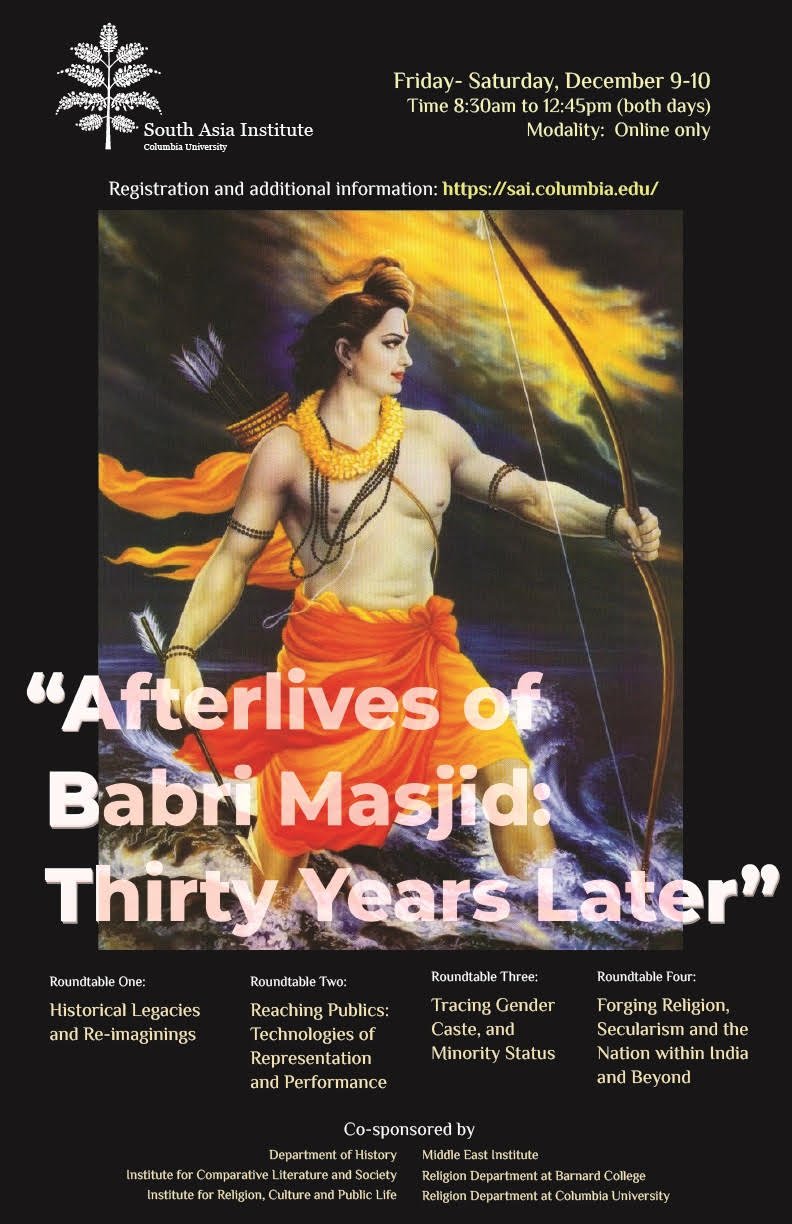
A two-day event on the 30th anniversary of the destruction of the Babri Masjid. Featuring roundtable discussions on: Historical Legacies and Reimaginings; Technologies of Representation; Gender and Caste; and Religion, Secularism and the Nation. Panels each morning and afternoon on Zoom.

The recent Dobbs v. Jackson decision puts the function of race in settling the matter of reproductive rights (to say nothing of reproductive justice) on display, showing the two to be crucial in establishing the legitimating reason and unreason of the decision. This talk considers how the convergence of race and reproduction in this decision can be an occasion to examine the enduring tie between the political and theological as manifest in the Supreme Court’s function in US governance. A key source of the court’s decision to overturn Roe and Casey is the sense that preserving those precedents is inconsistent with both the Constitution and the United States’ “history and tradition of ordered liberty.” Taking the dependence of the court’s ruling on the significance of order to conceptions of liberty, this talk shows how the afterlife of racial slavery and reproduction’s entanglement in the decision reveals a political theological sense of epistemological and existential order, and not only sovereignty, that is foundational to the court’s authority, power, and function.

In this event, co-organized with and held at the Museum of the City of New York, curator Azra Dawood will be joined in conversation by leading scholars of religion in New York City, exploring the intersections of the public and private, the political, secular and sacred. In conjunction with an exhibit at MCNY that launches November 16.

In the past decade, artists, curators, and art historians have been increasingly exploring performative and installation work tied to spiritual manifestations. The retrieval of Indigenous and Afro-Diasporic belief systems and cosmogonies has been at the heart of this discussion as the art world becomes more decolonized, decentered, and polyphonic. This revamped spiritual turn in the arts signals an interest in building new, interconnected epistemologies with healing practices as a central source of concern. This conversation, with two leading figures in the Caribbean art world, will highlight how ritualistic and collective acts can provide us with tools to build more sustainable relationships with nature and with each other.

The house has long been an ideal locale for horror. The home is intended to be our primary space of security and control, a reflection of our identity and values. The single-family detached house, synonymous with family and domesticity, has long been considered the intrinsic domain of women. But what happens to the home when the traditional patriarchal family structure is challenged, and the predictable stability of the house becomes unreliable? In this talk, Leila Taylor, the author of Darkly: Black History and America’s Gothic Soul, will look at supernatural spaces in film and literature, the image of the witch’s house, and how the home of the single, childless, autonomous woman became symbols of both enchantment and dread.

Few would question petroleum’s historical importance to our nation, or the critical role that Christianity has played in shaping its contours. Yet what happens if we link both entities together and place them at the center of modern American history? In this talk Darren Dochuk will explore how, from its earliest discovery during the Civil War to the present, this liquid resource assumed sacred form as the nation's special blessing and its peculiar burden, the source of its prophetic mission in the world. In the boardrooms, drill sites, pulpits, and pews of this country’s oil patches, meanwhile, petroleum executives, wildcat producers, and rank-and-file workers who mutually embraced oil as God’s gift fundamentally transformed US religion and politics—boosting America's ascent as the preeminent global power, fueling the rise of the evangelical Republican Right, and setting the terms for today's debates over energy and environment. With an eye to current trends, and America’s moment of crisis, in this talk Dochuk will measure the legacies of religion and oil’s distinctive bond.

This year marks the 100th anniversary of the publication of Carl Schmitt’s book, Political Theology. In that time, but especially in the past few decades, Schmitt’s notion of sovereignty, his assertion of the persistence of theological appeals in secular politics, and the very idea of “political theology” itself have been hugely influential. They have shaped our understandings of everything from state power to the “War on Terror” to the abject subject. Schmitt has also been controversial, not least given his work as a Nazi ideologue and jurist. In this panel discussion, leading critical thinkers reflect on the past, present, and future of both Political Theology and political theology. What does this concept offer now for an understanding of our world? A century on, how should we think about—and act upon—the notions of sovereignty, miracles, and sacrifice that Schmitt, and many others, have brought to the fore?

Before Joseph Smith was the American prophet who claimed to have translated The Book of Mormon, he was a seer and magician who used occult tools to search for treasure supposedly buried in the hills of upstate New York. While the mainstream Church of Jesus Christ of Latter-day Saints tends to underemphasize the folk-magic elements of Joseph Smith's biography, there are some people, both inside and outside of the Church, who not only see magic and esotericism as an important aspect of Smith's religious career but even see magic as a part of their own contemporary practices. Join us as anthropologist Jon Bialecki guides a roundtable discussion on the role of magic in historical and contemporary Mormonism and some of the tarot decks recently crafted.
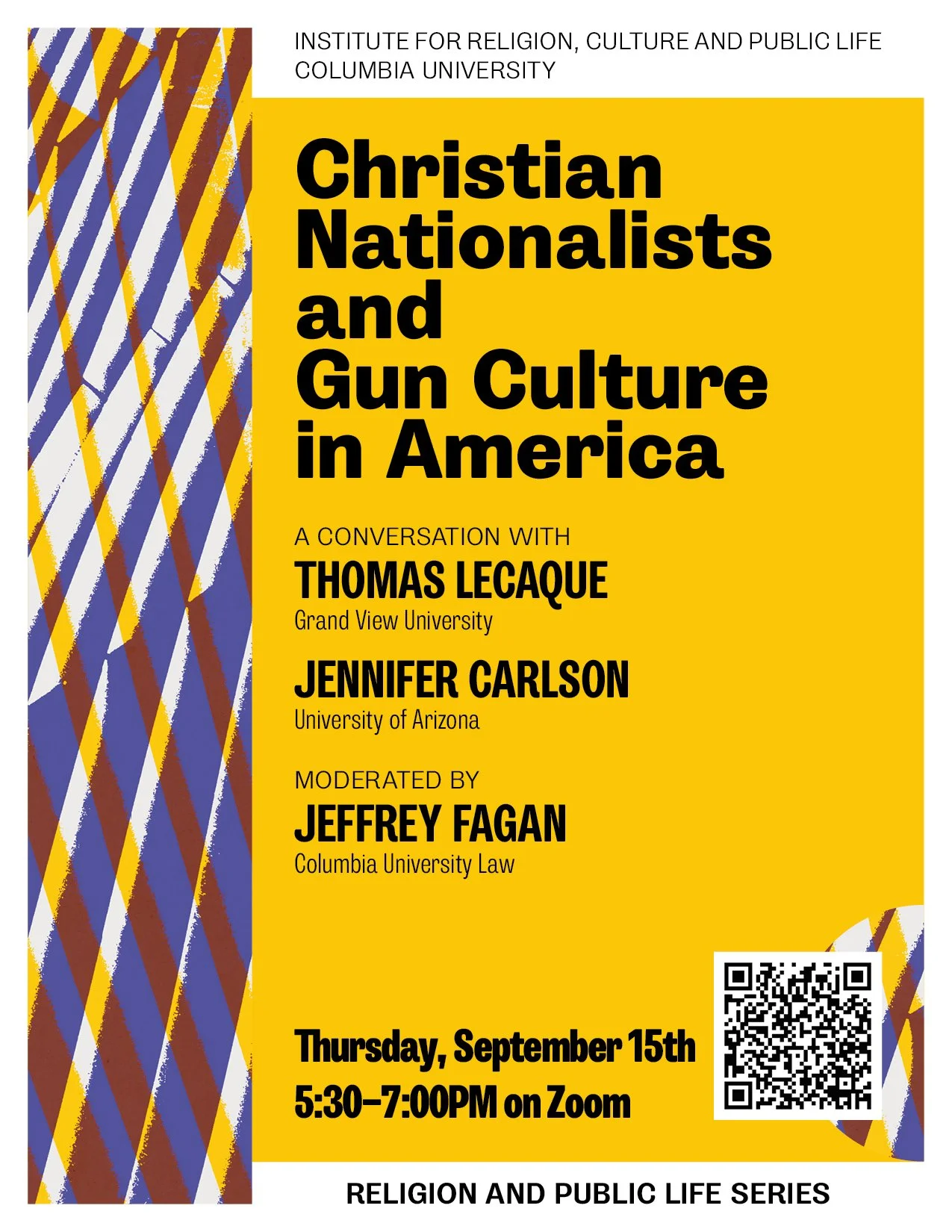
Gun culture in America has deep and varied roots. But the merging of contemporary Christian nationalism and this culture is a worrisome and dangerous trend in need of much greater exploration. In this discussion, leading experts on guns in relation to religion, race, policing and the law address the trend in a broad outline, while also highlighting particular developments related to Christian nationalist imaginaries: marketing of the "Crusader" rifle; liturgical use of AR-15's by Rod of Iron Ministries; the proclamation of the AR-15 as the gun of apocalypse by former Lt. Gen. Jerry Boykin; and the use of bullet rosaries by some branches of radical traditionalist Catholics.
A.Y. 2021-22

A lecture by Robin Veldman (Texas A&M University), moderated by Obery M. Hendricks (Columbia).
Researchers who are interested in understanding how religion affects Americans’ attitudes toward climate change have typically conceptualized religious influence as emerging from within organized religious traditions. On this view, if religion affects Catholics’ climate attitudes at all, it will be through a specifically Catholic source such as Pope Francis’ encyclical Laudato Si’ or though the influence of other Catholic parishioners. I suggest that this view may be missing a significant vector for religious influence on attitudes toward climate change: conservative media. Examining the transcripts of the top-rated Fox News program The Glenn Beck Program from 2009 to 2011, I explore how the eponymous host framed climate change in Christian nationalist terms as a threat to the Founding Father’s vision for America. I suggest that ostensibly secular media sources may be an under-researched mechanism by which religion is shaping climate attitudes, one that is worth exploring because of this religiosity’s ability to provide a sense of firm foundations in uncertain times.

A lecture by Alexis Wells-Oghoghomeh (Stanford University).
Enslaved people in the United States used materials and evinced cosmological ideas that challenged, expanded, and transcended Western European epistemological understandings of “religion,” even as said practices were presented as foils to the category. As a category deployed by researchers and a range of practices wielded by enslaved practitioners in the U.S. South, conjure names a collection of practices rendered opaque both in terms of its scholarly imprecision and its deliberate obfuscation of bondpeople’s complex inner lives by its practitioners. Often presented as base, violent, and problematically sensual due to its ties to foreign “magic,” outsiders’ renderings of conjure served as justification for American enslavement and masked the violence of slaveholding religiosity, while reifying the one-dimensionality of “slaves” in American discourses. At the same time, this historical racist stereotyping and vilification of bondpeople’s religions has often yielded a historiographical reluctance to theorize the ways religion and violence intersected in the religious productions and understandings of the enslaved. The result is often an equally one-dimensional rendering of enslaved communities. Reflecting upon the “dangerous magic” of categories like conjure in the study of religion and slavery, the presentation examines what violent practices reveal about intimate and communal conflict in the lives of southern enslaved people and the limitations of methodological categories when impeded by centuries of epistemic and historical violence. Through an examination of the case of Josephine, an enslaved woman accused of poisoning her slaveholders and killing their infant child, I explore the ways bondwomen weaponized ritual knowledge and racialized fears of Black women’s ties to harming protocols to respond to gendered forms of violence in the slavery era.

A workshop organized by Maria Jose de Abreu (Columbia, Anthropology), Bruno Reinhardt (Federal University of Santa Catarina), and Valentina Napolitano (University of Toronto).
This workshop aims to establish a dialogue between the critical turn in religious and secular studies and debates around the rise of the radical populist right in the Americas. It explores comparatively new populist theopolitical formations in their relation to a) sovereignty and soil, b) charisma and theatricality; c) neoliberalism and secular-religious assemblages. Whereas the correlation between the continent’s recent turn to the extreme right side of the political spectrum and changes in the religious field (growth of evangelical and Catholic charismatic Christianity) has been widely noticed, the nature of such cross-fertilization remains insufficiently theorized. Our purpose is to explore this theme through comparative inquiry on the shifting structures of religious and political authority in the region, including their theo-political entanglements. We assume that the concept of theopolitics (political theology “from below”) can be a valuable resource to grasp why and how political authority is being newly infused with a theological dimension at a moment in which the liberal democratic social pact is going through a widespread legitimacy crisis. From a geopolitical inception of the Americas and an intra-disciplinary standpoint, we also argue that theopolitics allows for a better understanding of ongoing transformations of theological discourses and practices in the light of an incarnated politics.

A book talk with Josef Sorett (Columbia, Religion), Barbara Savage (UPenn), Brad Braxton (St. Luke’s School), and Nyasha Junior (Temple)
This book brings together an interdisciplinary roster of scholars and practitioners to analyze the politics of sexuality within Black churches and the communities they serve. In essays and conversations, leading writers reflect on how Black churches have participated in recent discussions about issues such as marriage equality, reproductive justice, and transgender visibility in American society. They consider the varied ways that Black people and groups negotiate the intersections of religion, race, gender, and sexuality across historical and contemporary settings.
Individually and collectively, the pieces included in this book shed light on the relationship between the cultural politics of Black churches and the broader cultural and political terrain of the United States. Contributors examine how churches and their members participate in the formal processes of electoral politics as well as how they engage in other processes of social and cultural change. They highlight how contemporary debates around marriage, gender, and sexuality are deeply informed by religious beliefs and practices.
Through a critically engaged interdisciplinary investigation, The Sexual Politics of Black Churches develops an array of new perspectives on religion, race, and sexuality in American culture.

A panel with Jane Bennett, John Modern, and Alda Balthrop-Lewis. Moderated by Branka Arsic.
Thoreau’s life and work provide a productive entry point into a discussion of religion and climate. Alongside his own curiosities surrounding religion, the immanent, and the transcendent, his legacy within environmentalism and climate studies has often been harnessed in ways that approximate or play upon the sense of a spiritual or spirited conviction. Where is “religion” in—and for—Thoreau? And how, if at all, should it be understood in relation to the environmental movement and contemporary climate activism?

A lecture by Malcolm Gaskill (University of East Anglia, UK), moderated by Julie Stone Peters (Columbia, English).
In the late 1640s and early 50s strange things began to happen in the Massachusetts township of Springfield. As tensions rose, rumours of witchcraft spread, and the community became tangled in a web of anxiety and suspicion, fear and recrimination. This lecture tells the story of Hugh and Mary Parsons, a troubled married couple at the eye of the storm, and explores the uncertain relationship between the theory and practice of witch-beliefs, as they appeared in one particular historical case-study.

A lecture by Catherine Wanner (Penn State). Moderated by Valentina Izmirlieva (Columbia).
Religion is pivotal to how the relationship between the Russian and Ukrainian peoples is understood. This talk offers a comparison of religious affiliation prior to the war and the spate of complications that have been introduced since the invasion.

A lecture by Starhawk (witch, peace activist, and ecofeminist).
For over forty years, Starhawk has been a key figure in movements cultivating engaged approaches to magic and ecofeminism. While her work is situated outside the mainstream of academic discourse, it often speaks directly to the conceptual framings of secular modernity and public life. In this talk, Starhawk brings her work and experience to bear on a crucial topic in these times: the difference between magic and “magical thinking”—the rampant denial, conspiracy theories, and general irrationality swamping society today.

With Elizabeth Kolbert (author), moderated by Mark Taylor (Columbia, Religion).
Elizabeth Kolbert’s Pulitzer Prize for The Sixth Extinction: An Unnatural History established her reputation as today’s most important and influential science writer for the general public. Exploring caves, underwater worlds, tropical rain forests, frozen Antarctica, and the heavens above, she brings back dire warnings about impending catastrophes and the urgent need to respond before it is too late.
In this event, Mark C. Taylor, who teaches the philosophy of religion at Columbia, will be in discussion with Kolbert about her personal background and long experience as a science writer. What are the most critical threats to human life as well as the survival of countless other species? How is the war on science to be understood? Can attitudes and policies change fast enough to respond effectively? And are there any technological solutions to this unprecedented existential threat?

A panel with Lisa Ross, Magnus Fiskesjo, and Ajinur Setiwaldi. Moderated by Andrew J. Nathan.
What’s happening in and beyond the camps in Xinjiang make occasional headlines here in the United States. But what should an extended discussion focus on? Newspaper accounts often frame the atrocities in relation to “Muslim minorities,” or the question as one of “freedom of religion.” Is this apt? If not—or if not wholly—how and why? To what extent do matters of race or culture also play a role? And how can we understand what’s happening today in historical perspective?
This event is co-sponsored by the Weatherhead East Asian Institute.

A panel with Elizabeth Perez (UC Santa Barbara), Graham Jones (MIT), and Yvonne Chireau (Swarthmore).
In what ways did colonial powers deploy the language of magic as a tool of domination? To what extent are magic and modernity mutually constitutive? How have stereotypes of superstition and the occult continued to mark (post)colonial subjects and minority communities? And, perhaps, what is to be done with respect to a rearticulation and reassertion of what gets cast as magic; can magic be decolonized?

A lecture by Molly Burhans (GoodLands). Moderated by Manan Ahmed (Columbia, History) .
Today, technology and science allow us to measure and track the state of our environment. We now understand the extent of damage caused by human activity and the critical situation in which we find ourselves. Civilization's continuation will be enabled not by our collective regression but by using our best technology, most advanced science, novel collaborations, and creativity to reframe our relationship with nature.
We have everything we need. We just need to be more aware of what we have, be aware of its current impact, and understand its problems and possibilities. Once we understand that, we can fully realize our property's powerful potential to shape the landscapes of our future—and our power to choose whether we will use it to create the just, flourishing future all humanity deserves. We have a choice. Choose to #MakeLandWorkForGood.

A panel with Randall Balmer, Ben Carrington, and Samantha Sheppard. Moderated by Frank Guridy.
What work do gestures do in public culture? How does the body signal convictions and commitment? Such questions have been especially important in recent years when it comes to the intersections of racial justice, social protest, and sports. By “taking a knee,” the boundaries between religious, political, and social forms of action are purposefully blurred. In this event, IRCPL brings together leading experts on sports, race, and religion to discuss the intersections of protest and piety in contemporary and historical perspective.

A book talk with Katherine Pratt Ewing, Rosemary Corbett, Anne Bigelow, Kelly Pemberton, and Anand Taneja. Moderated by SherAli Tareen.
Modern Sufis and the State brings together a range of scholars, including anthropologists, historians, and religious-studies specialists, to challenge common assumptions that are made about Sufism today. Focusing on India and Pakistan within a broader global context, this book provides locally grounded accounts of how Sufis in South Asia have engaged in politics from the colonial period to the present. Contributors foreground the effects and unintended consequences of efforts to link Sufism with the spread of democracy and consider what roles scholars and governments have played in the making of twenty-first-century Sufism. They critique the belief that Salafism and Sufism are antithetical, offering nuanced analyses of the diversity, multivalence, and local embeddedness of Sufi political engagements and self-representations in Pakistan and India. Essays question the portrayal of Sufi shrines as sites of toleration, peace, and harmony, exploring cases of tension and conflict. A wide-ranging interdisciplinary collection, Modern Sufis and the State is a timely call to think critically about the role of public discourse in shaping perceptions of Sufism.

A lecture by Ailton Krenak (philosopher, writer, and indigenous leader).
In this talk, the indigenous thinker and philosopher Ailton Krenak urges us to take seriously the value of the indigenous philosophies of the Americas when it comes to confronting the climate change crisis. The author of Ideas to Postpone the End of the World and A Vida Não Útil (Life is Not Useful), here Krenak offers a trenchant critique of the extent to which an understanding of the earth as a resource to be exploited has taken hold in the wake of globalization, as well as how the logic of consumption is enabled by the “cognitive abyss”—our inability to listen and to see what is happening to the world.

A lecture by Silvia Federici (Hofstra University), moderated by Jack Halberstam (ISSG)
One of the most worrisome phenomena of our time is the return, in various countries, of true witch-hunts, a persecution that, like in the past, affects particularly women. As the same time, we are witnessing a new interest in witches among feminists worldwide, as the figure of the witch is taken as the symbol of anti-patriarchal rebellion. In her presentation, Silvia Federici will discuss the significance of these different developments, and the strategies that feminist and other social movements are organizing to end the persecution of “witches.”

A lecture by Darryl Li (University of Chicago), moderated by Lila Abu-Lughod (Columbia, Anthropology).
Two decades into the Global War on Terror -- as well as of standard liberal and left critiques -- the animating specter of "jihadism" remains as obfuscatory and violent as ever. This lecture attempts to clarify the stakes and the harms of this invidious category. Believers call many things jihad -- from personal struggles for self-improvement to armed violence -- and debate over proper uses of the word. The concept of jihadism, however, designates only a subset of these many diverse activities. Yet the very act of delineating which invocations of jihad count as jihadism and which do not is an intervention into a debate among believers using criteria from outside the tradition. Jihadism inevitably gives rise to the implicit residual category, of "non-jihadist" jihads. What can we learn from this (non-)category and what are its stakes for thinking about radical politics more generally?
A.Y. 2020-21
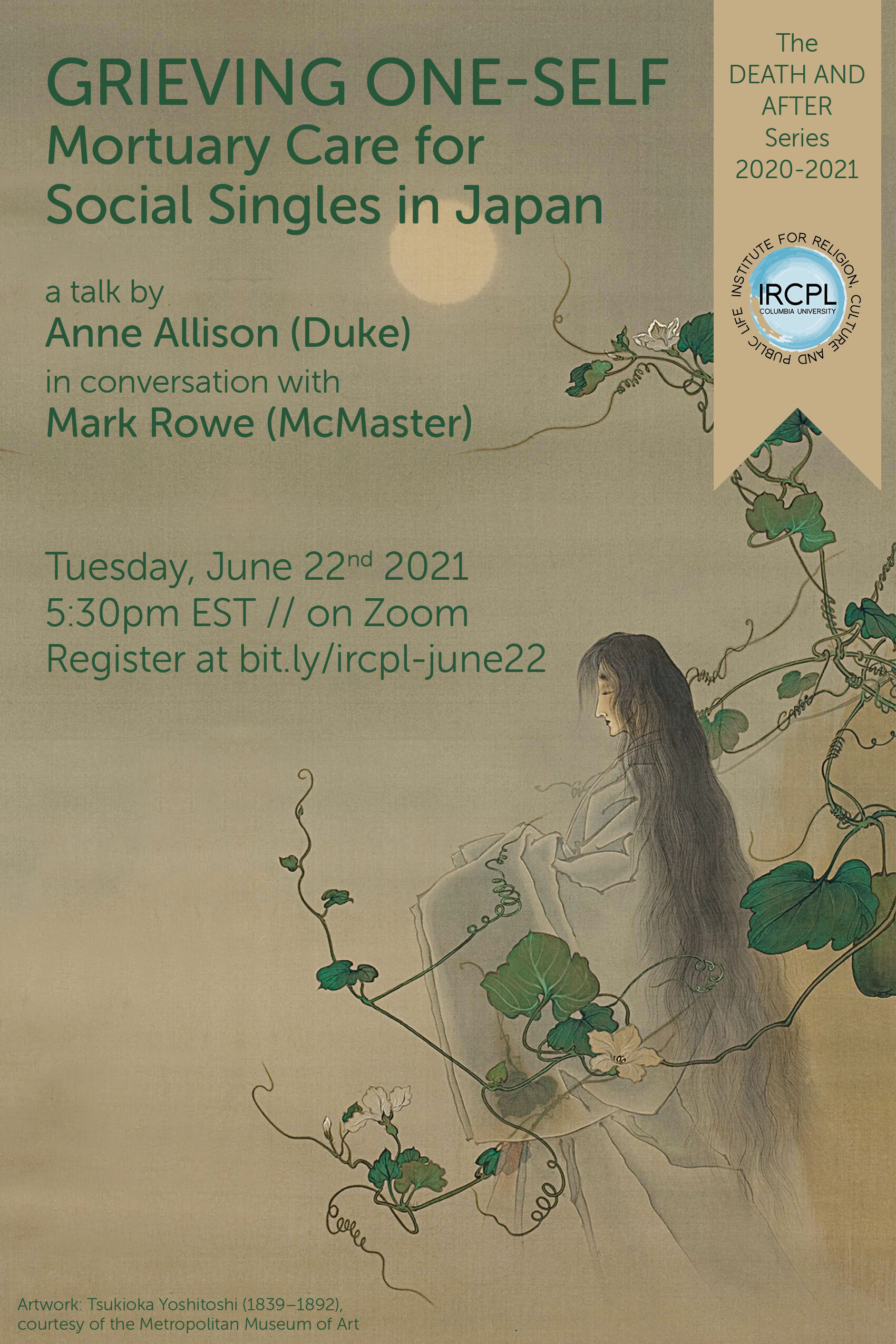
A lecture by Anne Allison (Duke University), moderated by Mark Rowe (McMaster University).
In the face of socio-economic shifts—a high aging/low childbirth population, decline in marriage and co-residence, irregularization of labor and precaritization of life—the family model of mortuary care that once prevailed in Japan is coming undone. As more and more Japanese live and die alone these days, they face the prospect of becoming “disconnected dead”: stranded without a grave to be buried in nor the social others to tend to it once there. Given the specter of such a bad death, new designs and trends are emerging for both necro-habitation and care-giving the dead. Prominent here is making mortuary arrangements for and by oneself while still alive (seizen seiri). Such anticipatory death-planning is the issue taken up in this talk. Based on fieldwork with new initiatives and services catering to a clientele of aging singles in Japanese, it is asked: What kind of grievability is this when the sociality of being cared for by others is handled by the self in anticipation of death? Mortuary presentism; a new ontology of the dead?

A conversation with Sergio Beltrán-García and Patricia Eunji Kim. Moderated by Marianne Hirsch.
The COVID-19 pandemic continues to ravage lives and livelihoods (especially of the most precarious, underserved communities) across the world. Traditional modes of mourning and commemoration are dangerous and ill-advised. How then, might communities and individuals grieve their losses? In this conversation, Sergio Beltrán-García (artist and activist) and Patricia Eunji Kim (art historian and curator) discuss the memorials, strategies, and stakes of commemorating the pandemic. If we dare to memorialize the pandemic dead, we must commit to unveiling the systemic inequities that left them so exposed. In other words, a memorial to the pandemic must also confront the very issues of labor, race, gender, and access that both created and exacerbated the conditions of vulnerability.

A panel with Eric Fassin and Maboula Soumahoro. Moderated by Emmanuelle Saada.
In recent months, French President Macron and members of his government as well as several groups of intellectuals and academics have sounded an alarm about the influence of supposed “Islamo-gauchisme” within French universities — a highly controversial term used to accuse left-leaning intellectuals of justifying Islamism and even terrorism. These attacks on an imagined “islamo-leftism” are often paired with a denunciation of post-colonial and decolonial studies, gender and sexuality studies, intersectionality, and studies of race and racism, deemed by critics to be political or ideological rather than scientific, and often maligned as an American import.
Invited panelists in this conversation will provide some political and academic context and offer definitions of the terms and arguments deployed in these attacks. What is really at stake here? How can these arguments be understood in today’s French political landscape? What do they reveal about the deeper transformations underway in the social sciences in France? How are they related to the fast-paced transformation of the role and organization of the University in French society? Why are post-colonial studies, race and gender studies, and “intersectionality” seen as “American imports” threatening the French “republican” model?

A workshop organized by Mana Kia and Debashree Mukherjee (MESAAS, Columbia University).
Things look different when viewed from the ocean. Categories such as territory, nation, and region can feel less certain, while embodiment, faith, and emotion can become more immediate. Our thematic – of oceanic imaginations – is designed to explore the theoretical, methodological, and material insights to be gained from an oceanic perspective on culture, religion, and the practices of everyday life. Oceans have for long been understood as conduits of movement linking different land masses and peoples together. As connective zones, oceans push us to break out of the siloes of area studies and think more expansively past the transnational. And thus, we know that the circulation of people, texts, goods, practices, and ideas have thick and deep histories across Africa and Asia. However, beyond economically determined factors, what are the constituting elements of these networks of circulation? Moreover, can we think the ocean not only as a space that connects to other places but as a watery, vital place with its own material specificities? In recent years there has been a shift away from a focus on mobility and economic history, towards cultural and interdisciplinary studies that take the "ocean-ness" of oceans seriously. Much of this work, tentatively termed “critical ocean studies,” is a response to the epistemic provocations of the Anthropocene. We propose to link the insights of an earlier model of oceanic studies that broke new ground in studies of race, colonialism, and material culture, with emerging interests that seek to revitalize our assumptions about the environment, aesthetics, and belief systems. As scholars committed to transregional, anti-imperial, and feminist historiography, the ocean is a particularly rich analytic to think with, as well as a mobile and material place to think from.

A book launch with with Winnifred Fallers Sullivan, Elizabeth Shakman Hurd, Sarah Dees, Osman Balkan, and Candace Lukasik. Moderated by Courtney Bender.
At Home and Abroad bridges the divide in the study of American religion, law, and politics between domestic and international, bringing together diverse and distinguished authors from religious studies, law, American studies, sociology, history, and political science to explore interrelations across conceptual and political boundaries. They bring into sharp focus the ideas, people, and institutions that provide links between domestic and foreign religious politics and policies. Contributors break down the categories of domestic and foreign and inquire into how these taxonomies are related to other axes of discrimination, asking questions such as: What and who counts as “home” or “abroad,” how and by whom are these determinations made, and with what consequences?

A lecture by Nusrat Chowdhury (Amherst College).
In this talk, Dr. Chowdhury takes the birth centennial of Sheikh Mujibur Rahman, the founding father of independent Bangladesh, as a point of entry in exploring the generative potential of mimicry in contemporary democracies. The repertoire of signs around the figure of Mujib around this historical moment (2021 marking the country’s 50th anniversary of Bangladesh) allows a vantage point from which to understand Bangladeshi political culture that came into sharp focus with the condensation of corporeal and symbolic energies around the replication of the leader’s likeness. The talk centers on the English-language novel, The Black Coat by Neamat Imam (2013), which pivots on the theme of impersonation and ends with the ongoing religious opposition to anthropomorphic reproductions. Chowdhury argues that the compulsion to mimic via statues, photographs, works of art, or reenactment ceremonies carries within it an ambivalent and generative politics. In every act of mimesis there is both a promise and a menace. Modern sovereign power manages this uncertainty through the specular and the spectacular, or what I describe as “monumentalised reproducibility.”

A lecture by Ebenezer Obadare (University of Kansas).
This presentation focuses on four women in their individual confrontations with four influential Nigerian pastors. Against the backdrop of the rise of the Pentecostal pastor as a cultural juggernaut across Africa, the performances of these women in varying contexts demonstrate that resistance to the power of the pastor can come from the most unexpected places, unleashing social dramas that amplify the contours and contradictions of the milieu in which pastoral power has become ascendant. Dr. Obadare argues that the way the respective encounters were resolved is a reminder of the power of the pastor and the durability of the structures that underpin and enable it. Second, it is a warning against the common tendency to flatten women’s agency by disregarding real and consequential class differences among them. While they often face similar political and cultural challenges, the way in which women combat or push back against such challenges- and therefore their success or failure in doing so- may vary depending on their education, social – and marital- status, shrewdness with the media, and other personal properties. Notwithstanding, women’s resistance provides an opportunity to juxtapose the antinomic character of women’s agency with the vulnerabilities of an impregnable-seeming pastoral hypermasculinity.

A lecture by artist Shiraz Bayjoo.
The Indian Ocean region, home to the multiple crossovers of Africa and Asia, would eventually shape European ambitions of Empire. Through colonization its sea routes and boundaries would be re-drawn from the movement of spice and silks to include the burgeoning demand for flesh and labour. It is at these sites of intense production that the plantation colonies of the Mascarene Islands were born. Previously uninhabited and strategically positioned, Mauritius was established early on as a slave colony. First settled by the Dutch, it was under French rule that the islands sugar plantations expanded, and ruled by the ‘Code Noir’ it would become known as the Maroon republic. Under the abolition of slavery, the island would later serve as the site for the ‘Great Experiment’, as the British replaced the demand for labour on its plantations with the Indenture labor system. This presentation will explore how racial hierarchies persist through reductionist narratives, exposing the enduring legacies of the Plantocracy. Through his on going practice and research focus, Shiraz Bayjoo unpacks how Mauritius’s Kreol identity is formed of Afro-Indo origins, and it is here through defiance from slave uprisings and escape into maroon communities where narratives of resistance and resilience begin to create new pathways of de-colonisation.

A panel with Susannah Crockford (Ghent University) and Will Sommer (The Daily Beast). Moderated by Elizabeth Castelli (Barnard, Religion).
“Apocalypse Pending: Religion, Politics, and Social Media” explores the growing popularity of conspiracy thinking in our current moment and its place in the history of religious movements, particularly in the US context. It considers how new media technologies have made it possible for the dissemination of such thinking on a scale unimaginable in the past, how the moral panic it generates is impacting social and political life worldwide, and whether there are measures available to control its spread or mitigate its effects.
This third panel in the series will focus on the violent insurrection at the US Capitol on January 6th, including the prominent appeal to ‘new age’ symbolism by such figures as the ‘Q Shaman.

A workshop with Murtala Ibrahim, Brian Larkin, Abdullahi Shehu, Mamadou Diouf, Matthew Engelke, and M. Sani Umar.
This workshop examines the relation between religion and public space focusing on Muslim movements in Northern Nigeria. It approaches the question in three main ways. First it brings to the foreground the many and diverse ways Muslim movements assert their presence over public space and the response by other movements and by the state. Second, it shows – in contradistinction to contemporary arguments – that these issues are not new and that control of public space has long been an aspect of West African religious life: from the masquerade tradition, to the rise of mass Sufi movements in the 1950s, to the emergence of African Independent Churches in the 1960s and 1970s. Finally, while we recognize these actions emerge from deep traditions within religious movements they also reveal a common religious ecology. Different religious movements – often bitter enemies – end up developing practices that borrow from each other even while they are in competition. We seek to draw out the broader nature of this mixed religious ecology.
This is a discussion-based workshop and depends upon participants reading the pre-circulated papers ahead of time.

A panel with Julie Byrne (Hofstra University), Jonathan Calvillo (Boston University), and Mary Anne Case (University of Chicago). Moderated by Katherine Franke (Columbia Law).
The recent appointment of Amy Coney Barrett to the Supreme Court generated a good deal of media coverage on her Catholic faith, especially her associations with the Catholic charismatic renewal. Barrett, though, is only one of six justices on the court who identify as Catholic, and as long ago as 2008 the political scientist Barbara Perry referred to the Supreme Court as “the Catholic Court.” Yet what might this mean, and how—if at all—can we trace the influences of Catholicism on judicial reasoning? The aim of this panel is to bring together scholars working across a range of fields—including law, history, critical race theory, and gender studies—to reflect on this question in relation to the Court’s recent past, present, and future.

A conversation with Karla Holloway (Duke), Nyle Fort (Princeton), and Rhon Manigault-Bryant (Williams College). Moderated by Josef Sorett (Columbia, Religion)
Arguments about black death abound. In certain iterations, the long story of black life in the Americas is one defined by the looming prospect of premature, untimely, or even primordial death; from the status of “social death” under the terms of chattel slavery, to the contemporary struggles for life in the face of state (and state-sanctioned) violence unto death. A variety of critics, in this tradition, have observed some variation on the theme of what the poet Claudia Rankine surmised in her 2015 book, Citizen: “the condition of black life is one of mourning.” Yet, as Rankine’s own work suggests, the conditions of black living have been animated by a robust set of artistic, cultural, political, and spiritual performances that speak to an abundance of methods for flourishing, and for affirming the truth of the now iconic hashtag #BlackLivesMatter—before, after, and in the midst of death.

With Isabel Wilkerson, author of Caste: The Origins of Our Discontents
Pulitzer Prize winning journalist Isabel Wilkerson is the author of the New York Times’ bestseller The Warmth of Other Suns. She will be speaking on her latest book Caste: The Origins of Our Discontents.
*this event is only open to CU/Barnard affiliates and will not be recorded

A lecture by Pamila Gupta (University of the Witwatersrand).
For this paper, Gupta proposes to take up the concept and physical space of a photographic ‘darkroom’ located in Stone Town, Zanzibar to explore a set of images from the Capital Art Studio (1930-present) collection produced by Ranchhod Oza (1907-1993), and inherited by his son Rohit Oza (1950-). She employs a concept of darkness to read this visual archive differently and propose multiple ‘other lives’ for a set of images. First, by bringing this African photography collection to light, she is taking it out of the ‘dark rooms’ of history in one sense (Hayes 2017) and exposing it for interpretation. Second, she focuses her lens on the Oza physical darkroom located in the back of the studio on Kenyatta Road in Stone Town, where photographs of a range of Zanzibari persons were both developed and printed and that open up the darkroom as a place of photographic complexity and sensorium, and not just mechanical reproduction (Jansen 2018). Third, Gupta develops darkness as a form of beauty in certain images of sky, water and skin from this archive that showcase Zanzibar’s position as an Indian Ocean island and port city whilst under rule by the Omani Sultanate (1698-1964) and British Protectorate (1890-1963). Fourth, she conceptualizes the Zanzibar Revolution of 1964 as a time of visual darkness, which temporarily restricted photographic practices operating in Stone Town under the new Afro-Shirazi political party. Throughout her analysis, Gupta uses a framing of ‘darkness’ to interrogate photography as an aesthetic practice deeply immersed in materialities and metaphors of dark and light, black and white, and as integral to Zanzibar’s oceanic islandness.

A panel with Karla Rothstein (Columbia GSAPP) and John Bruce (Parsons School of Design). Moderated by Maggie Jones (The New York Times Magazine).
Join us for an evening with Karla Rothstein (Columbia GSAPP) and John Bruce (Parsons School of Design) as they discuss their respective projects on how we may care for the dead and the dying. As an architect, Karla Rothstein has been at the forefront of efforts to transform the ways in which we commemorate and place the dead, especially given constraints of space in urban cemeteries and environmental costs of cremation. Through his work as a film maker, John Bruce documents the power of human connections with the dying, who are all too often marginalized from the wider currents of everyday social life. Together, their work raises urgent questions about how to understand life in proximity to death—questions of design, which are just as much questions of dignity and care.
A panel with Sarah Posner (author and journalist) and Kathleen Stewart (UT, Austin). Moderated by Courtney Bender (Columbia, Religion).
As the historian Richard Hofstadter famously pointed out more than half a century ago, conspiracy thinking or “the paranoid style” runs deep in the American political psyche. With an eclectic religious population (many of whose ancestors fled persecution in Europe for their beliefs: Puritans, Quakers, Anabaptists, Huguenots, Catholics, Jews), the United States may be exceptional in its political DNA—a combination of religious fervor and persecutory fear that, while generally latent, sporadically erupts in the body politic. The right-wing fear of social welfare policies as godless and unholy is one current manifestation of this particular political psychology. Another is the increasing online presence of apocalyptic religious sects, of which QAnon is an articulation.
“Apocalypse Pending: Religion, Politics, and Social Media” explores the growing popularity of conspiracy thinking in our current moment and its place in the history of millenarian movements, particularly in the US context. It considers how new media technologies have made it possible for the dissemination of such thinking on a scale unimaginable in the past, how the moral panic it generates is impacting social and political life worldwide, and whether there are measures available to control its spread or mitigate its effects.

A conversation with Mohamad Amer Meziane and Etienne Balibar. Moderated by Nadia Abu El-Haj.
2020 has already been marked by two major, historical events: COVID-19 and Black Lives Matter. This dialogue is an attempt to determine how political philosophy might help us think about them. In particular, it will probe how the unfolding crisis might force us to rethink our concepts of violence and the political. The pandemic is now inseparable from the question of the state and of the forms of violence it deploys. Does this signal a ‘return’ of the state to the center of politics, or simply its unmasking? How are we to think about violence both before and after the pandemic? How do empire and colonialism still structure the present? To what extent is Islamophobia part of systemic racism and practices of surveillance? How does Islamophobia overlap with anti-Blackness both in Europe and the United States? How do 9/11 and the War on Terror still determine the reactions of nation-states to the pandemic and are these reactions reducible to a generalized state of exception? And, finally, is 2020 the beginning of a new historical time?

A panel with Joan Donovan (Harvard) and Brandy Zadrozny (NBC News). Moderated by Matthew L. Jones (Columbia, History).
As the historian Richard Hofstadter famously pointed out more than half a century ago, conspiracy thinking or “the paranoid style” runs deep in the American political psyche. With an eclectic religious population (many of whose ancestors fled persecution in Europe for their beliefs: Puritans, Quakers, Anabaptists, Huguenots, Catholics, Jews), the United States may be exceptional in its political DNA—a combination of religious fervor and persecutory fear that, while generally latent, sporadically erupts in the body politic. The right-wing fear of social welfare policies as godless and unholy is one current manifestation of this particular political psychology. Another is the increasing online presence of apocalyptic religious sects, of which QAnon is an articulation.

A lecture by Derek Peterson (University of Michigan).
In what ways—under the eight year dictatorship of Idi Amin—was religion made public? Amin came to power in 1971 at a conjuncture in the history of technology: the new broadcasting capacities of radio allowed him to govern as a dictator, to set the pace of public life, to obliged everyone to march to the same tempo. Religion had to be reoriented. The space for dissident forms of Christianity and Islam was radically narrowed; pentecostals, Bahais, Adventists and other nonconformists were imprisoned, their property was seized, and their religious lives were foreclosed. At the same time new standards of religious conduct—particularly the notion of ‘African Traditional Religion’—were given substance in scholarship and in public culture. It was part of a process by which political life was evacuated of competition and loyalties were centred around the president.

A lecture by Amitav Ghosh.
In the West, no matter whether in economics, science or indeed, fiction, climate change is almost always imagined in relation to the future. In the global South the imagining of climate change is markedly different. This talk will examine some of the differences between the two perspectives.
The event recording will be available on our Youtube channel for seven days after the event.

A conversation with Joshua Dubler, Vincent Lloyd, Rev. Lynice Pinkard, and Kempis “Ghani” Songster. Moderated by Kendall Thomas.
Changes in the American religious landscape enabled the rise of mass incarceration. Religious ideas and practices also offer a key for ending mass incarceration. Activists-scholars Joshua Dubler and Vincent Lloyd advance these bold claims in their new book Break Every Yoke, which weaves religion into the stories about race, politics, and economics that conventionally account for America's grotesque prison expansion of the last half century. By foregrounding the role of religion in the way political elites, religious institutions, and incarcerated activists talk about incarceration, Break Every Yoke is an effort to stretch the American moral imagination and contribute resources toward envisioning alternative ways of doing justice.
Dubler and Lloyd will join us to discuss their work in relation to the Black Lives Matter movement and the ongoing protests. They will be in conversation with pastor, writer, and activist Lynice Pinkard, and Kempis “Ghani” Songster, a former juvenile lifer and founder of the advocacy group The Redemption Project.